



Who is the ATP's best defender? – Data analysis based on TDI



In the previous five articles, we analyzed the quality of ATP players' serves, returns, forehands, backhands, and offensive play using the TDI index system.
Today, let's focus on defense. Through the defensive evaluation metrics in the TDI system, we will measure and analyze who is the most formidable defender among ATP players.
1. What metrics does TDI set for defensive evaluation, and how do they differ from traditional defensive data?
In tennis, "offense wins applause, defense wins championships." Good defense can neutralize an opponent's offensive advantage and even turn the tables, becoming key to winning the match. For general spectators, evaluating a player's defensive ability often boils down to saying "solid defense" or "strong saving ability." Occasionally, simple metrics like "break point success rate" or "defensive scoring rate" are mentioned, but it's hard to clarify "where the player's defensive strengths lie" or "why they can neutralize the opponent's powerful attacks."
The defensive metrics in the ATP-TDI system completely break the limitations of traditional defensive data, creating a "full-dimensional, refined" defensive evaluation tool. Its core logic is a closed loop of "looking at the defensive process, outcome, and strategy," contrasting sharply with traditional defensive data that only "looks at the outcome." Traditional defensive data resembles a "simple defensive scorecard," merely telling you "how many defensive points were scored." Meanwhile, TDI defensive metrics are like a "detailed defensive analysis report," explaining "why the rally was defended" and "where the defensive strengths and weaknesses lie." This helps professionals improve their defensive skills and allows general viewers to better understand tennis defensive tactics.
2. Three major categories of core defensive metrics, covering "process-outcome-strategy"
First category, Defensive Shot Quality (DSQ): Measures the physical threat level of each defensive shot. How fast is this return? How strong is the spin? How precise is the placement? This determines the difficulty of the opponent's next attacking shot.
Second category, Defensive Efficiency: Measures the efficiency of defensive actions in converting to advantage or points. After defending, what percentage of rallies are ultimately won? What percentage successfully transition into one's own offensive state?
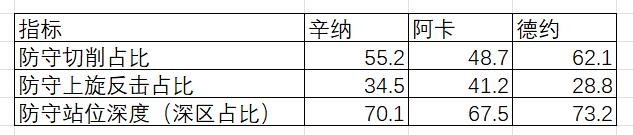
Third category, Defensive Tactics Distribution: Analyzes a player's strategic choices during defense. Is it habitual slicing or blocking back, or daring to use topspin backhands for line changes? Is the stance very deep, or actively stepping forward to intercept?
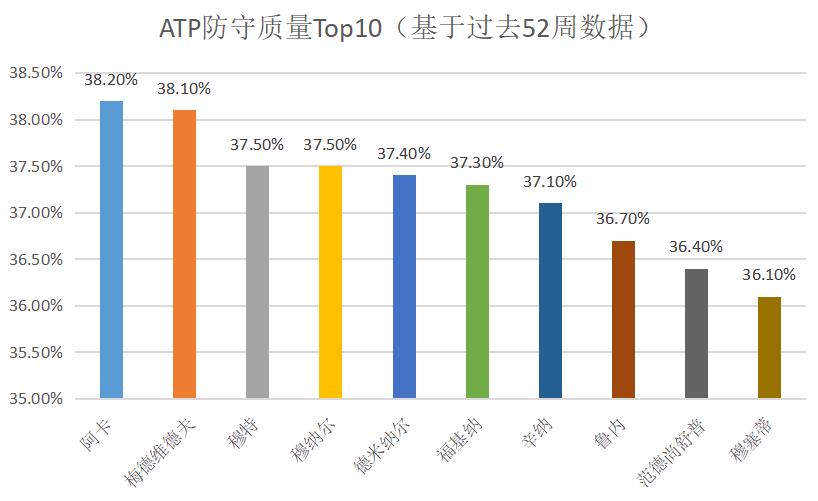
Based on these three major categories of metrics, ATP lists the Top 10 rankings for defensive quality over the past 52 weeks, as shown in the figure below.
3. Comparative analysis of defensive quality metrics for Sinner, Alcaraz, and Djokovic
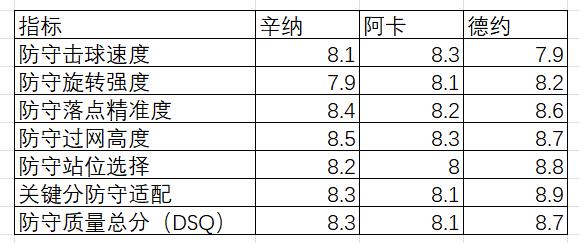
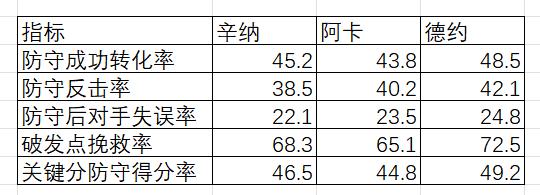
Combining publicly available ATP data from the past 52 weeks, we again take Sinner, Djokovic, and Alcaraz as examples to compare their core TDI defensive metrics. This allows us to intuitively understand the function of TDI defensive metrics and clearly see the differences in their defensive styles.
1. Defensive Quality Metrics
2. Defensive Efficiency Metrics
3. Defensive Tactics Distribution Metrics
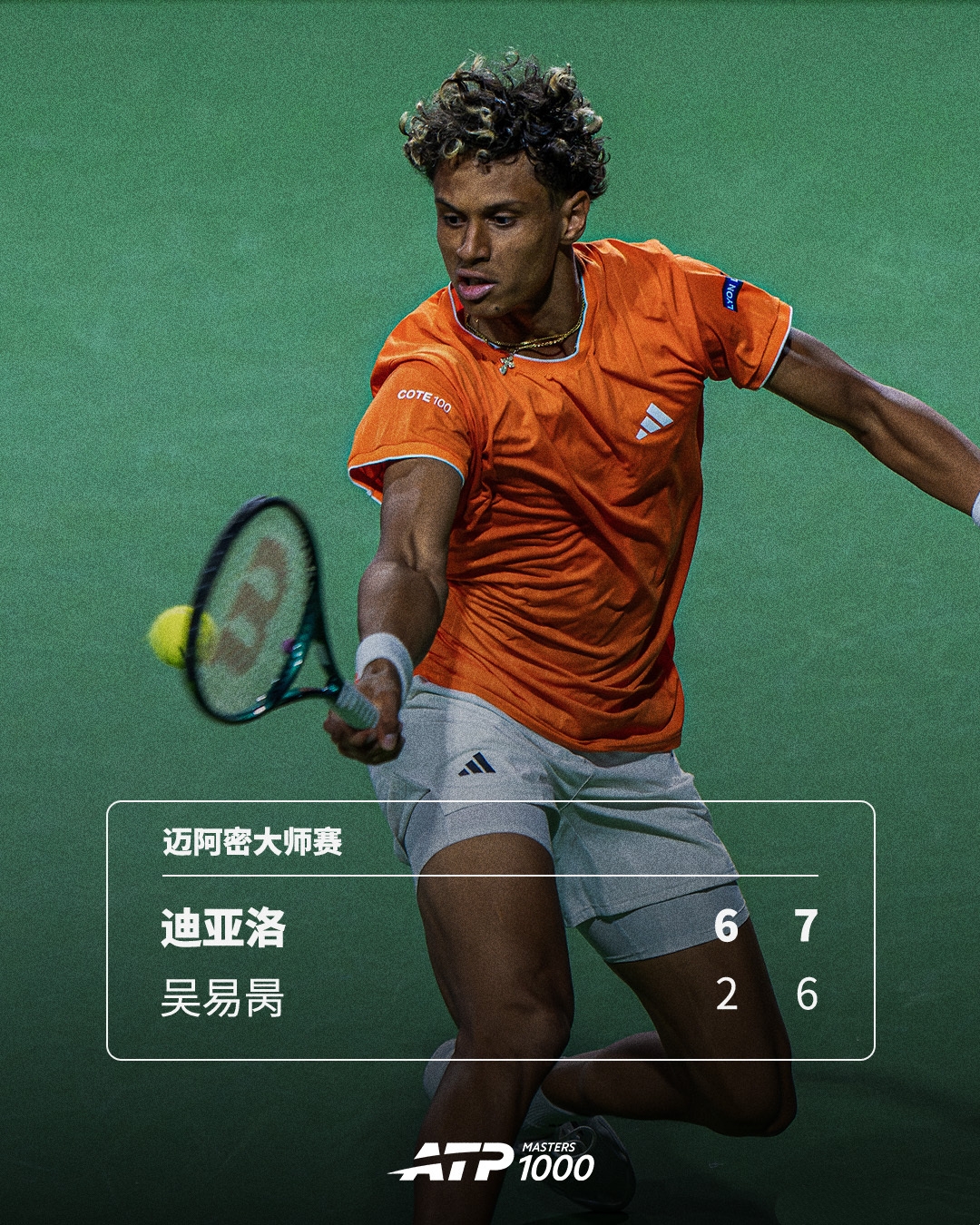
A brief update: In the first round of the Miami Masters, Wu Yibing, playing with a wildcard, lost to Canadian player Diallo 2-6, 6-7(3), failing to advance to the second round.
Through these three major categories of metrics, aided by AI, we can analyze the defensive characteristics of these three players.
(1)Djokovic: Truly a defensive master. His total defensive quality score, placement precision, net clearance control, and key-point defensive adaptation all rank first. His defense is not simply blocking shots; it is a "soft pressure" with strong tactical intent. Through precise placement and spin, he greatly limits the opponent's attacking space. This directly reflects his highest defensive success conversion rate and break point save rate.
(2)Alcaraz: His defense is full of aggression. Although his overall quality score is not the highest, his defensive counterattack rate and opponent error rate after his defense are very high. He prefers using topspin counterattacks, seeking offensive opportunities within defense, displaying a bold style.
(3)Sinner: His defensive ability is very balanced, with all metrics at a top level. His defensive strategy lies between Djokovic and Alcaraz, capable of consistently returning balls deep while also possessing certain counterattack ability.(Source: Tennis Home Author: Yun Juan Yun Shu)

 Links
Links
 Contact
Address:UNIT 1804 SOUTH BANK TOWER, 55 UPPER GROUND,LONDON ENGLAND SE1 9E
Number:+85259695367
E-mali:[email protected]
 App
App


