



The reasons behind the split between Alcaraz and Ferrero have sparked four major speculations, with Marca reporting a significant salary cut for the new contract coach.



Recently, current world number one Alcaraz suddenly announced via social media the end of his seven-year partnership with his coach, causing an immediate uproar in the public.
The surprise from outsiders is quite straightforward: on one hand, Ferrero helped Alcaraz secure two Grand Slam titles this year at Roland Garros and the US Open, reclaiming the world number one spot—such a successful coach leaving abruptly is hard to comprehend; on the other hand, Ferrero has been with Alcaraz since his junior years, quietly supporting him for seven years, deeply understanding him, and even regarded as a “second father” to Alcaraz. Therefore, emotionally, even if Ferrero were to leave, it shouldn’t have been so sudden or untraceable.

Ferrero’s words in the split announcement further fueled speculation. He wrote, “Farewells are never easy, especially after all we have been through together.” He also said, “How I wish we could continue together. But I am sure that beautiful memories and wonderful people will meet again at some crossroads in the future.” This seems to imply Ferrero did not leave voluntarily; he wanted to continue but was forced out.
As the public delved deeper into the root causes of their split, multiple reports emerged, but they only made the truth more confusing, leaving many fans puzzled.

Speculation one on the breakup: pressure from competition with Sinner.
This theory originates from analyzing Alcaraz’s split statement, where he said, “After a journey of seven years together, Juan (Ferrero) and I have decided to end the player-coach relationship. We reached the pinnacle of success together. I believe if we must part ways in our sporting journey, it should be from this high point we have worked so hard to achieve.”
“Parting at the peak?” Many fans interpret this as Ferrero no longer being able to provide Alcaraz with fresh inspiration or constructive advice, directly leading to their separation.
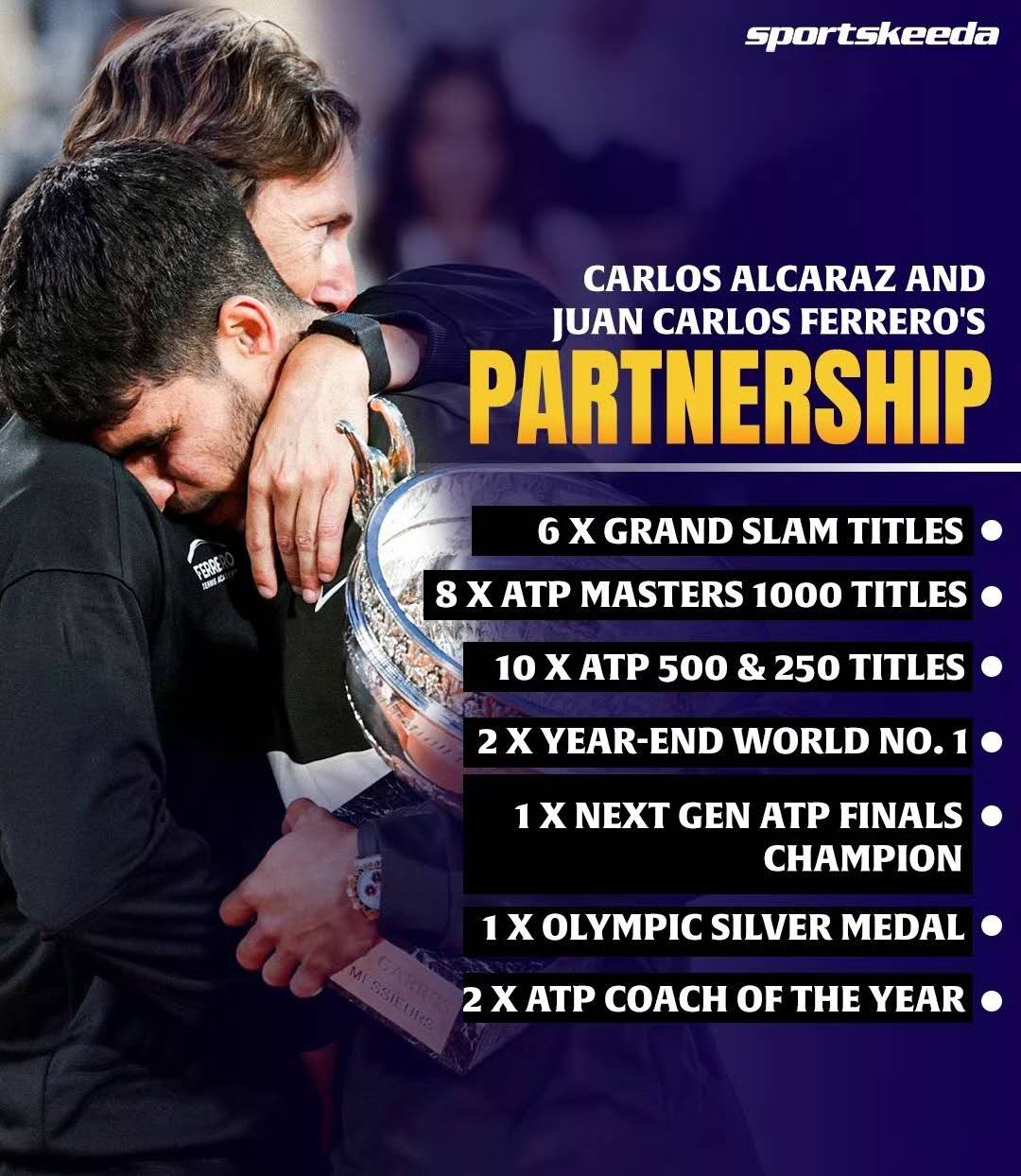
“From Alcaraz’s perspective, perhaps Ferrero can no longer spark new motivation. It’s similar to Swiatek’s case—once the skills are mastered, the next step is to seek new challenges,” wrote one netizen.
How credible is this explanation? Personally, it makes some sense. Not long ago, after returning home to receive an award, Alcaraz explicitly stated that winning the 2026 Australian Open would be the team’s top strategic goal for next year, which is reasonable since that title would complete his career Grand Slam.
But the question arises: with Sinner’s capabilities, will winning the Australian Open be easy for Alcaraz? Clearly not. Especially considering Alcaraz’s losses to Sinner in the Six Kings exhibition and the year-end finals, plus Sinner’s team adapting to Alcaraz’s new tactics and techniques, the Spaniard urgently needs “new inspiration” to maximize his chances against Sinner at the Australian Open next year. Under this logic, ending cooperation with Ferrero and hiring a new coach is understandable.
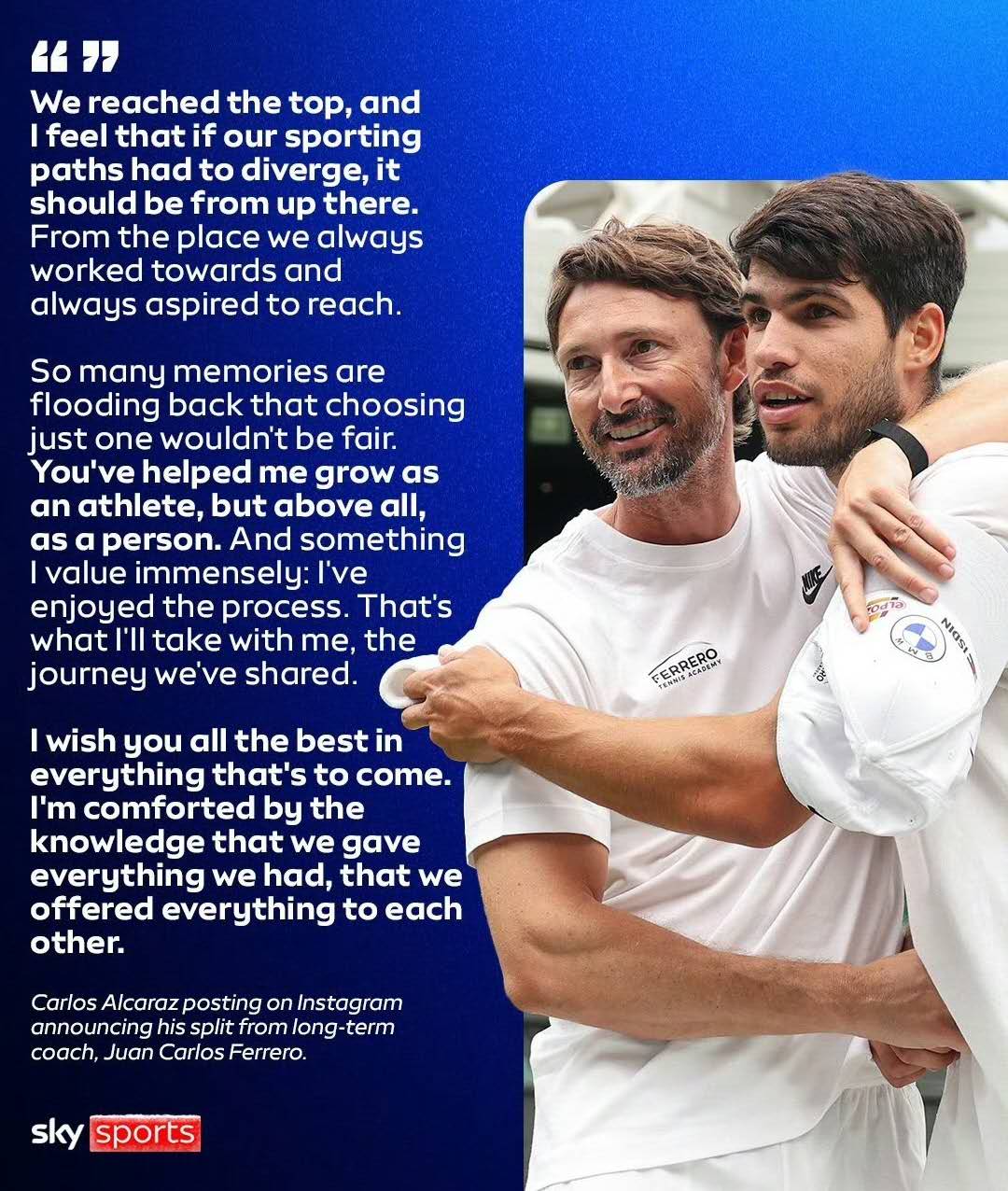
As a netizen put it, “Ferrero can no longer offer more to Alcaraz, so this timing might be the best moment to part ways. However, the split is filled with uncertainty: it could mark the start of a new leap or potentially signal a period of confusion.”
Some fans even cited numerous examples to support this view, noting that in professional tennis, it is common to pay coaches large bonuses while dismissing them at any time.
Classic cases include Djokovic parting ways with his long-time coach Ivanisevic in early 2024 after six years and 12 Grand Slam titles together. Another example is Naomi Osaka firing Sascha Bajin just two weeks after winning the Australian Open in 2019; similarly, Bajin was recently named Coach of the Year. Also, just days before this year’s US Open, Coco Gauff dismissed her coach Matt Daly, despite winning the French Open under his guidance.
Speculation two on the breakup: financial issues.
According to Spanish media, the fundamental reason for their split may relate to reducing the coach’s commission.
Marca reported that Ferrero received a contract last Saturday morning that he had to accept or reject within 48 hours. The document contained several unacceptable clauses, including a significant pay cut. Previously, Ferrero earned about 30% of the player’s income, but the new contract fell far short of that.
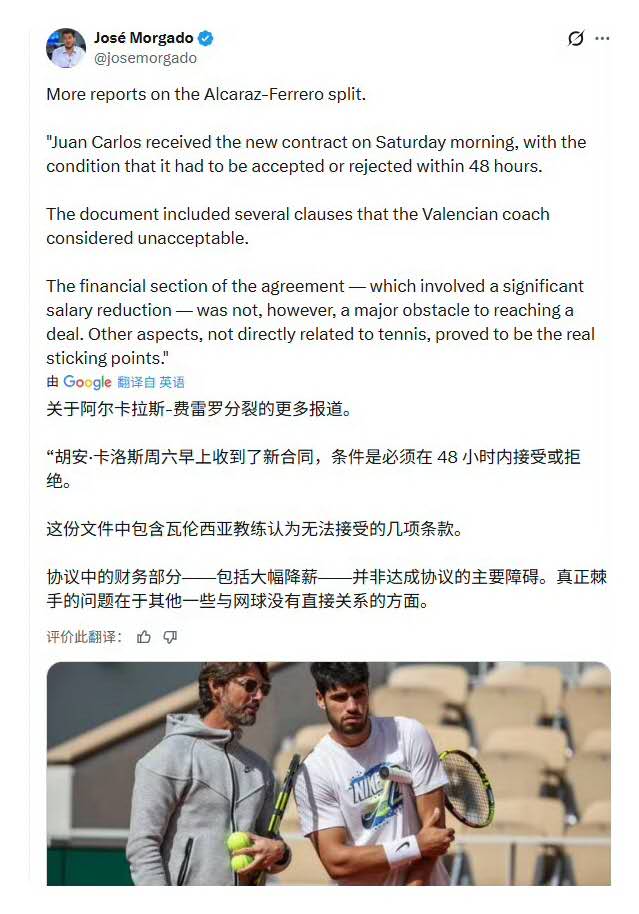
Notably, the deadline to accept or reject was Monday morning. Ultimately, on Wednesday, their partnership since 2018 officially ended.
This speculation sparked heated online discussion. Some questioned, “On one hand, with Alcaraz’s nearly 50 million annual income, it’s hard to imagine money causing a fallout. On the other hand, given their past success, losing Ferrero would be more harmful than beneficial, as such a key coach’s departure undoubtedly affects performance. So if the split was purely about money, it would be a loss, not a gain.”
Speculation three on the breakup: conflicts triggered by participation in exhibition matches.
This idea comes from a Spanish journalist’s report, revealing that irreconcilable differences caused the split. Though he didn’t specify the disagreements, insiders said that in recent months, Alcaraz expressed a desire for greater freedom in behavior, while Ferrero wanted him to follow instructions more faithfully.
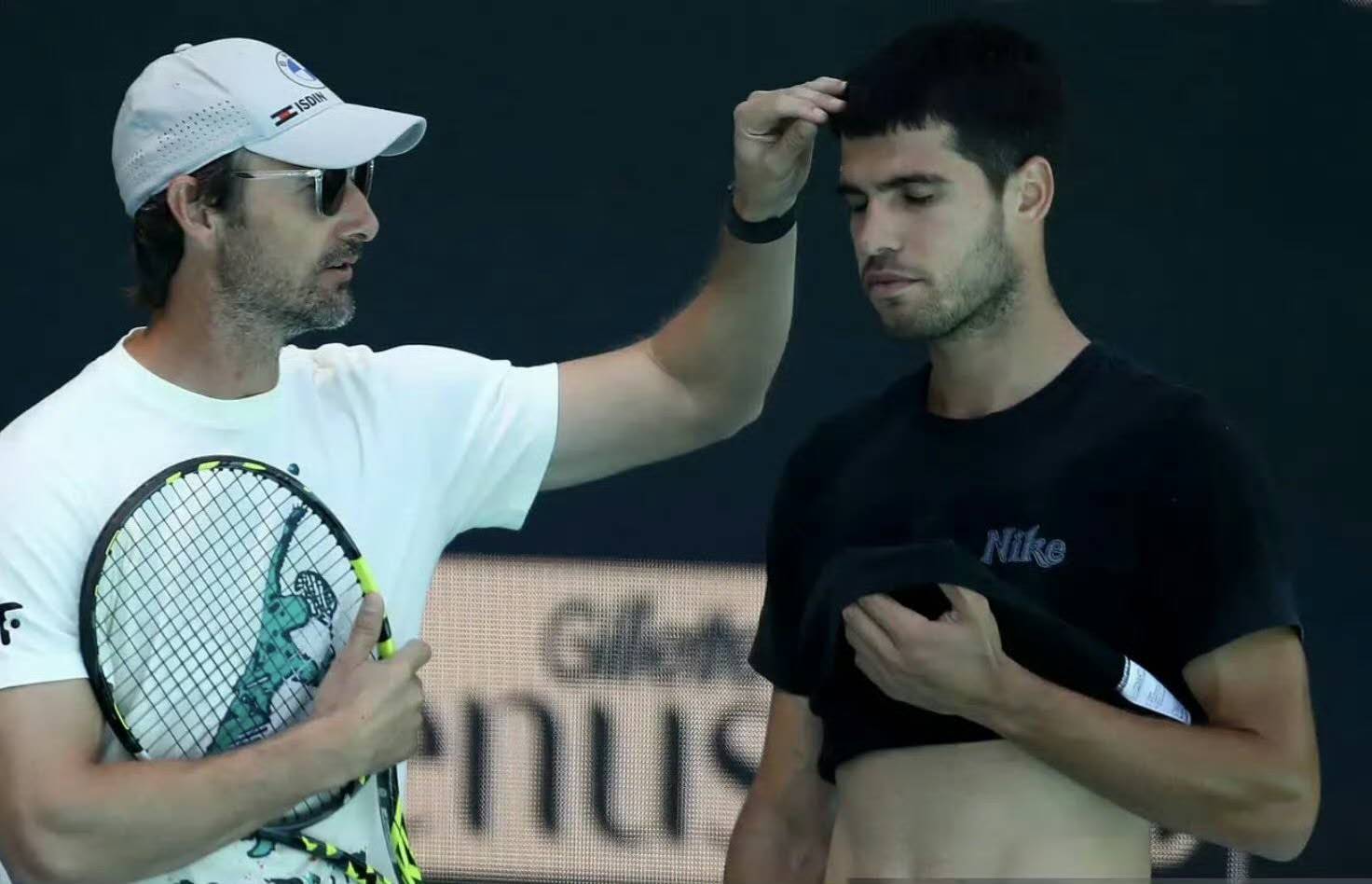
Looking at Alcaraz’s team situation, Ferrero was the only member who could “speak frankly.” Multiple reports also suggest Ferrero was unhappy with Alcaraz’s frequent participation in exhibition matches during the off-season. In many interviews, Ferrero urged Alcaraz to focus seriously on his career and emulate legends like Federer and Nadal, but Alcaraz did not fully agree.

However, is this alone enough to end their cooperation? One netizen commented, “I don’t think this explanation is reasonable. Clearly, this is not an irreconcilable conflict; both sides have room to compromise, so this is unlikely to be the breaking point.”
Speculation four on the breakup: strong interference from Alcaraz’s father.
Another theory about the split points to strong family interference, based on comments from Alcaraz’s first coach Kiko Navarro. On a Spanish radio show, he remarked, “I feel the final decision was not made by Alcaraz himself, but those who made it certainly had their reasons.”
Though he did not elaborate, he clearly suggested that neither side ended the partnership voluntarily. So if both wanted to continue, why did they eventually part ways?

Spanish journalist Ángel García revealed, “There were major disagreements between Alcaraz’s father and Ferrero over managing the player’s career. When you feel your work is valued at a certain level but your employer significantly lowers that evaluation, tensions inevitably arise.”
Some netizens believe much of the conflict stemmed from Ferrero’s inability to accompany Alcaraz at key tournaments, with the trigger likely being an unexpected injury at the Tokyo event this year.
“The situation worsened after the Tokyo tournament. Alcaraz’s father was unhappy that Ferrero couldn’t attend most of the second half of the season’s events, and Ferrero’s insistence on more specialized training at his tennis academy further escalated tensions,” wrote one foreign netizen.

However, some questioned, “Again, family interference? Many reports say Alcaraz’s father takes a hands-off approach and fully trusts Ferrero. This claim is hard to believe and seems contradictory to many reports.”
Regardless, since the split is a fact, both parties must move forward. As Spanish legend Corretja commented, this move will help Alcaraz mature faster and take more responsibility for his actions and decisions.(Source: Tennis Home, Author: Lu Xiaotian)

 Links
Links
 Contact
Address:UNIT 1804 SOUTH BANK TOWER, 55 UPPER GROUND,LONDON ENGLAND SE1 9E
Number:+85259695367
E-mali:[email protected]
 App
App


