



Player complaints take effect! ATP introduces new on-court regulations to ensure players' health and safety



Remember the Shanghai Masters? Extreme heat and overwhelming humidity pushed the world's top players to their limits. The harsh playing conditions sparked numerous complaints and even forced some players to retire mid-match. “It’s my fault: the heat and humidity overwhelmed me,” Sinner admitted after battling Griekspoor for two and a half hours under the Shanghai stadium lights.
Cramping, fainting, a series of retirements during matches, and images of players visibly suffering ultimately compelled the ATP to act by introducing a set of new measures aimed at mitigating the effects of extreme heat. Now, it appears the ATP Board has officially approved a new heat policy, set to take effect starting with the 2026 season. So, what exactly does this regulation entail?
In singles matches, ATP’s new heat measures are designed to provide players with genuine relief when conditions become hazardous. Cooling breaks will be formally integrated into the match protocol; if the match reaches a third set, players may request a 10-minute rest period after the second set to recover.
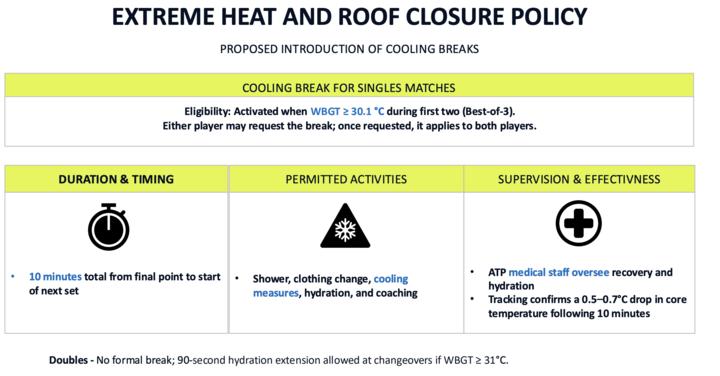
When the WBGT index (which combines temperature, humidity, and solar radiation) exceeds 32.2°C, the match will be automatically paused upon the request of any player, and this rule applies equally to both competitors. How long will the pause last? And what are players allowed to do during this time?
The ATP Board has approved the implementation of the new heat rules starting from the 2026 season. The main provisions are as follows:
· Introduction of cooling breaks
· Upon any player’s request, a 10-minute rest after the second set
· Match suspension when WBGT exceeds 32.2°C
Additionally, the rest period is defined as “10 minutes total from the end of the last point to the start of the next set,” providing players with a clear window to physically reset. During this time, players may shower, change clothes, use cooling methods, hydrate, and even receive on-court coaching, all aimed at safely lowering body temperature. Importantly, this process will not rely on subjective judgment.
The ATP medical team will oversee the entire recovery process, monitoring players’ hydration and overall physical condition. According to tracking data, this rest period is highly effective — after 10 minutes of cooling, players’ core body temperatures typically drop by 0.5 to 0.7 degrees Celsius, which was a key factor in the rule’s formal adoption. However, doubles matches will follow a different protocol.
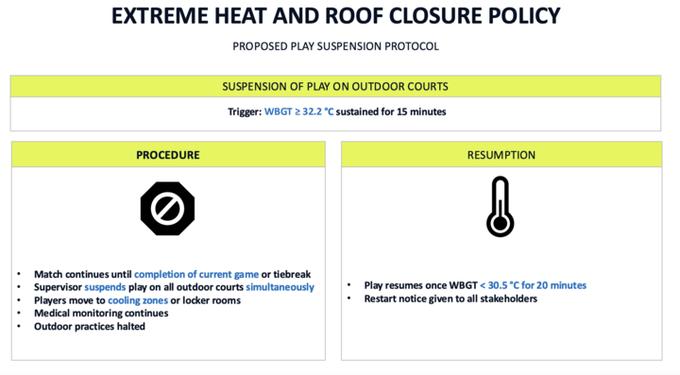
Beyond individual match measures, the ATP has also established a comprehensive suspension mechanism for outdoor courts. If the WBGT remains at or above 32.2°C for 15 consecutive minutes, all outdoor courts will simultaneously halt play.
Matches will pause after the current game or tiebreak finishes, with players directed to cooling zones or locker rooms while medical monitoring continues and outdoor training suspends as well. Play will only resume once the WBGT has stayed below 30.5°C for at least 20 continuous minutes and official confirmation is received.
Despite numerous player concerns about heat and scheduling—especially at this year’s Shanghai Masters—Goffin holds a different view, pointing to extreme heat, high humidity, and longer rallies as the main factors. He explained, “Top 10 players usually go deep in tournaments, so they play many matches. When the season nears its end and they face a unique event in nearly 35°C (unprecedented) heat with 80% humidity, it’s truly challenging.”
Still, Goffin noted that the ATP Tour runs from January through November, and players ultimately must manage their own schedules. Yet the debate over whether this is sufficient to protect players quickly reignited.
The discussion intensified when the idea of “slower courts” emerged. Federer hinted that some tournaments might be adjusting court speeds to help stars like Sinner and Alcaraz advance further, generating buzz. Zverev expressed similar concerns. Sinner firmly denied these speculations, stating that neither he nor Alcaraz has, or could have, any influence over court speed or tournament decisions.
Meanwhile, the physical toll of harsh conditions has become impossible to ignore. Goffin and Sinner are not alone—players such as Mahut, Ruud, Medvedev, Terrence Atman, and Wu Yibing have all been forced to retire due to heat. Those who continue competing have openly voiced dissatisfaction, criticizing the ATP for not implementing a mature, long-term heat policy like the WTA, reigniting calls for stronger player protections.(Source: Tennis Home, Author: Spark)

 Links
Links
 Contact
Address:UNIT 1804 SOUTH BANK TOWER, 55 UPPER GROUND,LONDON ENGLAND SE1 9E
Number:+85259695367
E-mali:[email protected]
 App
App


