



ASEAN Cup: A Pit Stop



From the very beginning of the Tiger Cup in 1996, Thailand's seven titles in 14 editions go beyond simple numbers. They affirm unrivalled supremacy, a vast silhouette that Thai football has draped over the rest of Southeast Asia.
The Thais' superiority is not a fleeting phenomenon at the national team level; it is backed by a solid foundation: the Thai League. To this day, it remains the model domestic competition in Southeast Asia, proudly ranking among the top seven most attractive leagues on the continent.
That strength was forged two decades ago, when BEC Tero Sasana proudly finished as runners-up in the 2002/2003 AFC Champions League, paving the way for extraordinary talents like Therdsak Chaiman to shine on the Asian stage before moving to play in Vietnam.
But the greatest turning point for Thai football came in 2007. At that time, the Thais courageously tore down and rebuilt their entire professional system—acquiring the operational format of the English Premier League and hiring a foreign CEO to manage it.
The mindset of daring to abandon old patterns in order to approach international standards is precisely the key that sets them apart from the rest of the "lowland." They accepted the pains of restructuring to transform clubs into independent sports business entities, operating systematically rather than relying on the breath and fluctuating pockets of wealthy patrons.
Looking at our neighbor gives us a jolt of reflection for the V-League. After more than a quarter of a century wearing the "professional" label, we still have a league that is modest in stature and has never touched the continental peak at club level. V-League bosses do not hesitate to spend billions, but much of that cash flows into short-term arms races rather than fundamental investment in the future. While the V-League's foundation still struggles with TV rights, pitch quality, and empty stands, the inevitable consequence is that the "overseas" journeys of our domestic stars to Japan, Korea, or Europe all end in silence due to a lack of preparation from the roots.
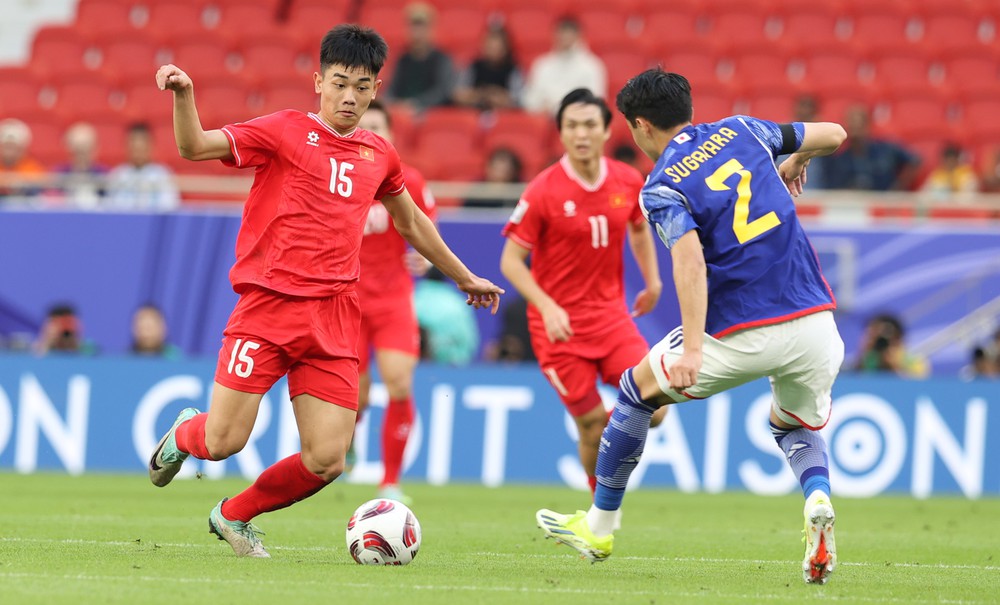
For progress, Vietnamese football must be regularly exposed to and compete against top continental football nations like Japan. Photo: Hoang Linh
The output of a football nation is always the national team, but the root that nurtures it must begin with the domestic league system, from youth academies to the superstructure of professional competitions.
At the upcoming 2026 ASEAN Cup, Vietnam's chance to reach the regional summit for the fourth time is very high. But look at the goal Thailand has touched seven times and ask yourself: After that glory, what next?! If we are only satisfied with the "village pond" throne, we will forever fall behind when venturing into the big ocean. The vast gap in level will immediately surface when Southeast Asian representatives are crushed by powers like Japan, Saudi Arabia, or Australia in World Cup qualifiers.
The Southeast Asian Cup or SEA Games gold medal, after all, is only a necessary condition, never a sufficient one. To break into the top tier of Asia and realize the World Cup dream, Vietnamese football must be regularly exposed to and compete against top football nations, at both club and national team levels.
The ASEAN Cup, in the end, should only be a stopover on the journey across the sea—absolutely not the final destination for an ambitious football nation!


Wonderfulshortvideo

User soccer has posted a video.



real madrid news today barcelona news today la liga news today lamine yamal goal today lamine yamal assist

WHAT A WEEKEND for Godolphin

It’s like watching the Mona Lisa being painted 🤯

Valid crash out‼️

haaland goal today haaland edit haaland injury news haaland vs ipswich man city 3-2 ipswich town

The walk in question 😮💨
 Links
Links
 Contact
 App
App