



ASEAN Cup: A Parallel Destiny and a Crossroads in the Flow of Time



A few days after the World Cup 2026 ball stopped rolling in North America, another ball began to roll in Southeast Asia. Just as FIFA President Gianni Infantino was still floating the controversial idea of expanding the 2030 World Cup to 64 teams, the ASEAN Cup—a tournament that just turned 30 years old since the 1996 Tiger Cup—quietly kicked off without any similar discussion about reinventing itself.
1. On July 22, Singapore's largest English-language newspaper, The Straits Times, published an article that carried a mix of pride and melancholy when discussing the chances of "The Lions"—the Singapore national team—at the ASEAN Cup 2026.
The article stated: "It has been 14 years since Singapore last reached the final of the tournament in 2012, which was also when they won their fourth and last title. That was followed by a chaotic period with eight coaches, and a drop to the world's lowest ranking of 173 in 2017 and 2018.
It wasn't until 2021 that Singapore returned to the semi-finals. Although they repeated this achievement in 2024, it is clear that The Lions are not on the same level as Thailand (7-time champions) and Vietnam (3-time champions). And even though they have now qualified for the Asian Cup for the first time, don't be mistaken—the team currently ranked 148th in the world remains a long shot for a fifth star on their badge."
The Straits Times added: "Even advancing past Group A is a major challenge for the Lions, as Cambodia has three naturalized players from Ivory Coast, Japan, and Uzbekistan. Beating Cambodia and Timor-Leste (two less experienced teams) in the first two matches is the minimum requirement to keep semi-final hopes alive, before their fate is almost sealed by tougher challenges against Vietnam and Indonesia.
After a long period of craving success, Singapore fans have become more realistic and now only hope to see some progress. Perhaps the most important thing is to look forward to the future from a few young players emerging through the development system."
Although it originated from the sponsorship of Tiger Beer in collaboration with the Southeast Asian Football Federation, later renamed the AFF Cup and now the ASEAN Championship (ASEAN Cup), in essence, it remains the regional championship for Southeast Asian teams. Official and unique. But as time passes, the ASEAN Cup cannot maintain the same importance it had in its early days.
When this tournament was born, the region's football scene had only the SEA Games as a biennial competition, the World Cup had just 24 teams, and the Asian Cup only had 8 teams. Competitive international playing opportunities were almost nonexistent for Southeast Asian teams. Therefore, the ASEAN Cup title at that time was nearly the only measure of class and status.
Thirty years later, the landscape has completely changed. The Asian Cup has expanded to the point where up to four Southeast Asian representatives can participate together. The World Cup, after already expanding to 48 teams, is now considering an increase to 64. The qualifiers for these two major tournaments have made regional encounters in Southeast Asia "as common as daily meals," but with greater significance. The number of official international matches each year is now so high that there is no need for additional FIFA Days friendlies.
This means that while the nature of the ASEAN Cup hasn't changed, its importance has naturally declined from the top spot. Its significance as a competitive arena for testing and honing standards has also diminished, as the top Southeast Asian teams now have the stature to arrange high-level friendlies against opponents with higher FIFA rankings. Moreover, to accelerate improvement, one must play stronger opponents. And such matches are now available to Thailand, Vietnam, and Indonesia, among others.
And in the current trend of naturalization among Southeast Asian teams, the ASEAN Cup is no longer the venue to convince players playing in Europe or America to join the national team. Not to mention that the ASEAN Cup is not part of the FIFA Days system, which forces clubs to release players. Consequently, due to natural circumstances, the ASEAN Cup is gradually losing its appeal.
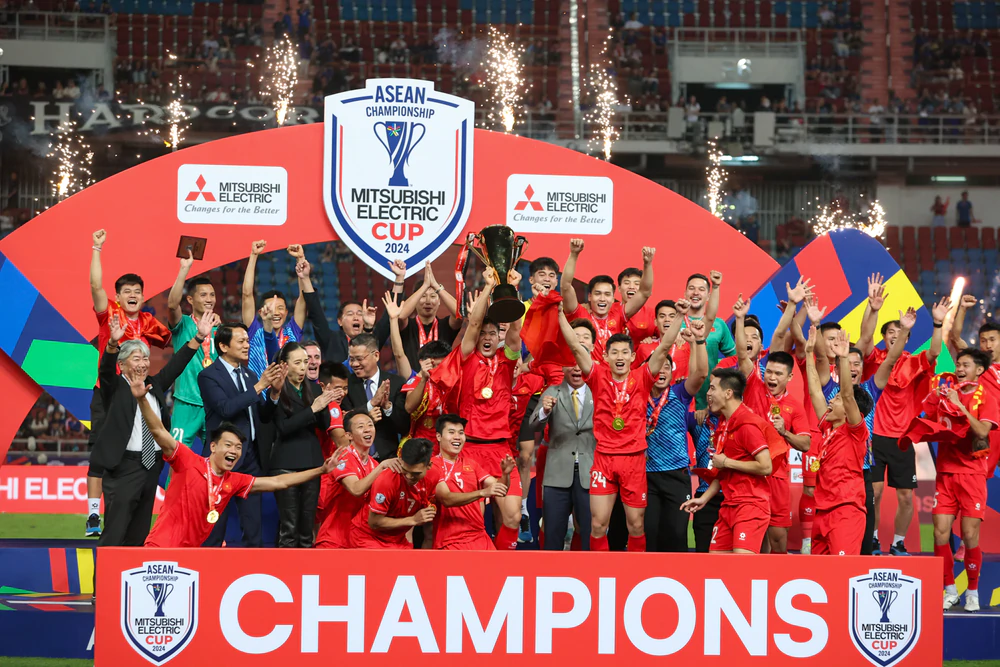
If the Vietnamese national team wins its fourth ASEAN Cup title in 2026, it would be a great joy for the fans. Photo: Hoang Linh
Nevertheless, we should not hastily conclude that the ASEAN Cup has lost its value. Let's look at it from the perspective of the article in The Straits Times. For this island nation's football, the ASEAN Cup remains a kind of positioning certificate, where a football nation establishes its true position in the region before dreaming of bigger stages. It is like a "high school graduation exam" that ensures the capacity to step up to a new level of understanding.
Practice has proven that the lack of a clear standing in the ASEAN Cup for many consecutive years was partly why football nations like Indonesia or Malaysia fell into a state of instability, unable to determine where they stood on the regional map.
Malaysia's recent scandal involving naturalization document fraud, which FIFA investigated and led to the case being taken to the Court of Arbitration for Sport, partly reflects the impatience of a football nation wanting to fast-track its progress instead of building a foundation from its own regional platform.
2. For Vietnamese football specifically, the term "parallel destiny" might be fitting when discussing our story with this 30-year-old tournament.
One of the foundations for this tournament was Vietnam's silver medal at the 18th SEA Games. That miracle ignited a wave of passion across Vietnam, effectively adding nearly 100 million potential consumers to the football market, and more importantly, making the race for the top spot in the region more crowded and competitive compared to the times when Thailand or Indonesia almost dominated alone.
From the moment of "The Starfruit of the Homeland" by the late delegation leader To Hien at the 1996 Tiger Cup, to the historic victory over Thailand at Hang Day Stadium in 1998, and then to the two trophy lifts at My Dinh in 2008 and 2018, nearly every major milestone of modern Vietnamese football is tied to this tournament. The 2008 championship was the sweet fruit of the professionalization process from the V-League, while the 2018 title marked the most brilliant period in history. By 2024, Vietnam used naturalized players for the first time to successfully defend the crown.
Even the lowest points on the sine curve of Vietnamese football are tied to this tournament. The first golden generation ended at the 2000 Tiger Cup. The collapse in 2004 sent the entire football scene into a decline that lasted until 2008. The crisis from the 2012 AFF Cup left even heavier aftereffects, which took until 2018 to recover from.
It is no exaggeration to say that the 30 years of the ASEAN Cup contain the entire rise and fall of Vietnamese football history. For a long time, despite reaching the SEA Games final four times, Vietnam could not touch a legitimate regional title until 2008. That means the ASEAN Cup, for Vietnamese football, is not just a launchpad but also a marker of the patience of a football nation that had to rebuild almost from scratch after the war. Because of this deep attachment, the tournament has become a part of the identity, a spiritual anchor difficult to separate from the nation's football life.
3. But precisely because of this deep attachment, it's time to ask the reverse question: Is Vietnam trapped in its own glory?
The ASEAN Cup is facing change as the FIFA ASEAN Cup is about to be born. Perhaps this tournament will become a place where teams test young players. Maybe the ASEAN Cup will reform its format, becoming a kind of "qualifying tier" where higher-ranked teams earn the right to play in a FIFA tournament. Whatever happens, after 30 years, the ASEAN Cup stands at a crossroads of the era.
And as if by "parallel destiny," the time has come for Vietnamese football to "change course." Standing at the 2026 crossroads, we need a more realistic and courageous perspective. At the 2024 ASEAN Cup, the Vietnamese national team began a strong reform process under Coach Kim Sang Sik by eliminating old elements and introducing quality naturalized players. Those are signs of change, showing that we are no longer satisfied with maintaining the status quo.
There is no need to deny or overly romanticize what the ASEAN Cup has brought over the past three decades. What needs to be done is to close that chapter of memory in the most complete way—by winning a fourth title in the style of Southeast Asia's No. 1 team—so that we can step forward peacefully. Ahead lies the 2027 Asian Cup with continental-level opponents, and beyond that, the dream of the World Cup.
Football truly develops only when people dare to think beyond the framework. The peace and "modesty" of the region sometimes serve as an excuse for slow change. For Vietnamese football, the ASEAN Cup has fulfilled its historical mission as a "measure" of class in the past. Now, let it become a launching pad for a new look, a new spirit, where we dare to move beyond old glories to reach for the bigger dreams of the modern football flow.


Wonderfulshortvideo

User soccer has posted a video.



real madrid news today barcelona news today la liga news today lamine yamal goal today lamine yamal assist

WHAT A WEEKEND for Godolphin

It’s like watching the Mona Lisa being painted 🤯

Valid crash out‼️

haaland goal today haaland edit haaland injury news haaland vs ipswich man city 3-2 ipswich town

The walk in question 😮💨
 Links
Links
 Contact
 App
App