



Timor Leste National Team at ASEAN Cup 2026: A Mission to Secure Historic Points


Placed in Group A alongside defending champions Vietnam, Indonesia, Singapore, and Cambodia, Timor Leste is still considered the weakest side. Their most achievable objective is to claim their first points in ASEAN Cup history. This modest milestone would nonetheless symbolize a turning point for the country's football development.
After four ASEAN Cup appearances (2004, 2018, 2020, and 2024), Timor Leste has yet to earn a single point. Their record of 16 losses, with only 9 goals scored and 68 conceded, is the clearest evidence of the gap between them and the rest of the region.
A Portuguese-Inspired Overhaul
The 2026 ASEAN Cup is the first regional tournament Timor Leste enters under Portuguese head coach Ze Pedro. The Timor Leste Football Federation's appointment of the former midfielder, who played over 200 matches in the Portuguese top flight, can be seen as the start of a long-term development strategy.
Upon his debut, Ze Pedro stated that his mission extends beyond the national team to include youth teams, with the aim of building a cohesive training system. This aligns with the federation's vision: embedding Portuguese football philosophy into the country's young football scene, rather than chasing short-term results.
After four consecutive losses in the 2027 Asian Cup qualifiers against the Philippines, Tajikistan, and Maldives, Timor Leste returned to a more suitable level of competition by overcoming Brunei with a 6-1 aggregate in the two-legged playoff to qualify for the 2026 ASEAN Cup. Although the opponent was not particularly strong, the two consecutive wins carried significant morale-boosting value. More importantly, having to play through the qualifiers gave Timor Leste extra time to test their squad, refine tactical execution, and build cohesion before entering the group stage.
In Timor Leste's 26-player squad for the 2026 ASEAN Cup, half are playing abroad—from Australia, Portugal, England, Ireland, Northern Ireland, Singapore, to Malaysia. Although most represent lower-tier clubs, training and competing in professional environments helps them accumulate valuable experience and brings a fresh look to the national team.
No Longer Southeast Asia's Punching Bag
Looking only at the FIFA rankings or head-to-head history, Timor Leste still struggles to be seen as equal to their group opponents. However, the competitive gap is gradually narrowing.
Under Ze Pedro, Timor Leste primarily uses a 4-2-3-1 or 4-3-3 formation. Against stronger opponents, they are willing to drop deep, cede possession, and wait for opportunities on fast counter-attacks. This is a pragmatic style suited to the team's current strength.
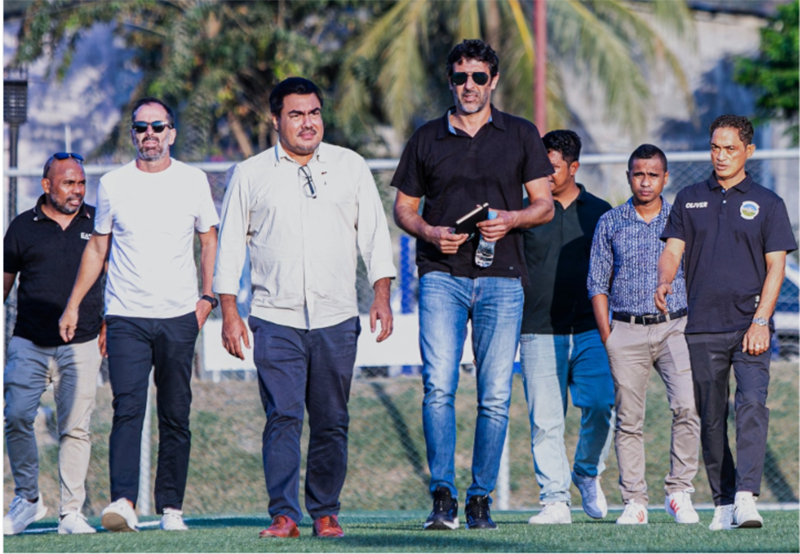
Can Coach Ze Pedro deliver historic points for Timor Leste? Photo: FFTL
A notable bright spot is the attack. João Pedro remains the most experienced striker, while Claudio Osorio, Zion Cruz, and Joao Rangel can provide unpredictability thanks to their overseas experience. Osorio was the standout player in the second-leg playoff win over Brunei, while Zion Cruz and Oatnasio da Silva both made their mark with crucial goals.
At the 2024 ASEAN Cup, Timor Leste put up a commendable performance against Malaysia. They led 2-1 at one point, forcing one of the region's strongest teams to fight hard for a 3-2 victory. This shows they have learned to trouble top sides rather than simply defending passively as before.
Of course, clear weaknesses remain. The defense lacks stability under sustained pressure, the organization of defensive play is not yet solid, and physical condition often drops in the final stages of matches, causing Timor Leste to lose control in the last 20 minutes. This is why they have frequently dropped favorable results in recent tournaments.
However, the noteworthy thing is that Timor Leste no longer easily gives up after conceding a goal. They maintain a fighting spirit, press when appropriate, and make the most of transition phases. This is a change in mentality—something that cannot be measured by statistics alone.
Just One Point Would Be Enough to Make History
In Group A, Vietnam and Indonesia are seen as the strongest candidates for the two semifinal spots. Singapore is more experienced, while Cambodia also boasts increasingly quality naturalized players. Therefore, Timor Leste's chances of causing an upset are slim.
But their ambition is not overly far-fetched. If they manage a draw against Cambodia or Singapore, Timor Leste will earn their first point in the ASEAN Cup after more than two decades of waiting. Given that the team has lost all 16 matches in four previous appearances, even a single point would be considered an unexpected success.
In reality, the development of a football nation is not always measured by trophies. For small teams like Timor Leste, success sometimes simply means narrowing the gap with stronger opponents, establishing a playing identity, and making every rival enter the field with respect rather than contempt. If the red-shirted team secures their first-ever point in the tournament's history, it will be an important milestone, proving that the overhaul under Ze Pedro is on the right track. The road for Timor Leste to rise into the competitive tier of Southeast Asian football is certainly still long. But every journey begins with the first steps.
Timor Leste Squad for the 2026 ASEAN Cup
Goalkeepers: Dylan Jose Niski, Alexandre Lima, Egidio Oliveira.
Defenders: Juvito Moniz, Jackson M. Pereira Fowler, Eric Tomas T. Silva, Joao Varudo, Ryan Harris Jom, Anizo Correia, Liam Fernando Farrugia.
Midfielders: Palomito Ribeiro, Natalino de Jesus, Claudio Osorio, Tristan Xavi Arrarte, Denilson Almeida.
Forwards: Paulo Gusmao, Luis Figo, Joao Pedro, Olagar Xavier, Angenuku Viegas, Joao Rangel, Gustavo Mota, Atanasio Guterres, Fabio Cannavaro, Zion Cruz, Alexandre Corsino.


Wonderfulshortvideo

User ceshi has posted a video.


User soccer has posted a video.

real madrid news today barcelona news today la liga news today lamine yamal goal today lamine yamal assist
WHAT A WEEKEND for Godolphin
It’s like watching the Mona Lisa being painted 🤯
Valid crash out‼️
haaland goal today haaland edit haaland injury news haaland vs ipswich man city 3-2 ipswich town
 Links
Links
 Contact
 App
App