



Spain will be unbeatable over the next two years.



From South Africa to North America, Spain claimed two world titles while keeping the same principles that revolutionized their football, making the ball the focal point of their approach.
Coach De La Fuente has taken the legacy that Luis Aragones started in 2008 to its peak with a squad whose average age of 26.1 is among the youngest at the 2026 World Cup, and they have the potential to establish dominance within the next two to four years.
Is Rodri important or not?
The team triumphed in North America with a system that cannot be replicated or imitated, turning ball-touch technique into a method of competition and victory. They defeated the strongest opponents who could challenge their status, from Germany, England, France, Portugal to Argentina, through ball control, rhythm, thinking speed, and movement ability.
All these factors are based on preserving their identity, despite modern football changing rapidly every day. It is not only about talent, passing, or movement but also about consistency.
The system's core is centered on Rodri's position, who serves as the brain of La Roja's movement mechanism. That role was confirmed at the 2026 World Cup, but the 30-year-old midfielder is not the entire strength of the red-shirted team.
This was also proven in the EURO 2024 final, after number 16 was injured and replaced by Zubimendi, Spain still maintained their strength to defeat the Three Lions. It should be noted that the Spanish team lost both of their most important midfielders, including Pedri, at that time.
Man City's struggles when Rodri was absent for over a season were valuable free lessons for the 64-year-old coach. La Roja cannot afford to repeat this mistake at a higher level. Precisely, this football nation is also overcoming the weaknesses that led to a deep crisis from 2014 to 2022, because it was built on the Barcelona core of Xavi, Iniesta, and Busquets. When this trio declined in form or left the pitch, the Spanish team no longer functioned normally and lost direction.
The principle emphasized by De La Fuente is not to build the system based on one or a group of players from a single club, but Spain needs to operate through passing triangles, third-man runs, a holding midfielder, width stretching, and players who create breakthroughs. This is about distributing responsibility, burden, and flexibility among all players in the system.
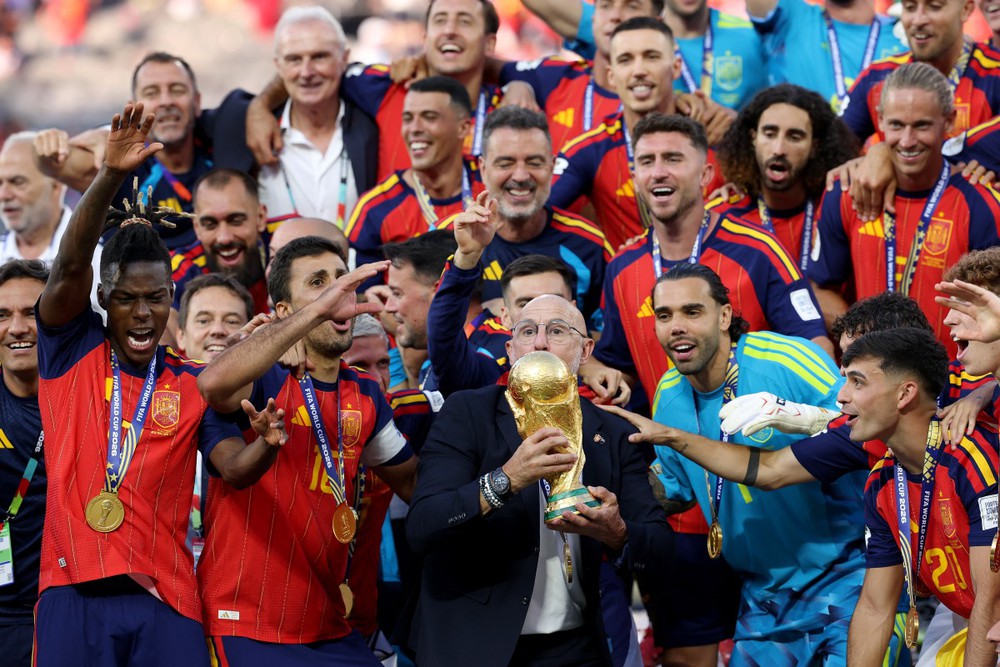
The current philosophy and principles can help Spain sustain success for another 2 or 4 years. Photo: AFP
Challenges from the philosophy
Spain has taken a big step forward compared to its clubs and academies, by building a method where the best individuals are no longer the sole condition for the system to function, but rather whoever is more suitable will be on the pitch.
This foundation will eliminate issues regarding specific personnel or positions, as well as the age of key players in the next 2 or 4 years. The important thing is whether the current playing philosophy can be further developed in the period leading up to EURO 2028 and the 2030 World Cup.
The crisis after EURO 2012 began not only from the fatigue of football brains but also from intellectual conservatism, with academies using tiki-taka as a guiding principle, training old-style rhythm keepers like Koke, Ceballos, or Thiago, which were also causes of failure.
Meanwhile, world football has entered a new era emphasizing speed, physicality, and transition, with schools like those of Jurgen Klopp or Hansi Flick. Even the master Pep Guardiola had to change his philosophy to be more pragmatic and direct.
The most practical question is how major rivals like France, England, Germany, Argentina, or Brazil will develop their philosophies to counter the system of the 2026 World Cup champions, who already possess players capable of meeting both physical intensity and tactical demands for years to come.
How to prevent an excellent control team from ever controlling the game at the pace they desire is what will drive the tactical upgrade and refinement of each team. And whether the aforementioned teams have enough time to develop faster than Spain, given that they are at different stages and have different issues.
If they cannot surpass in philosophy, how will they develop their strongest points to defeat De La Fuente's team?


Wonderfulshortvideo
messi goal today messi assist today messi highlights vs egypt enzo fernandez goal today romero goal today argentina goals today argentina 3-2 egypt


“Wonderful player, fantastic player, could not run” 😅
Neville, Keane and Wright DO NOT agree on the future of Argentina in the World Cup 👀
“It gave you everything” 👀
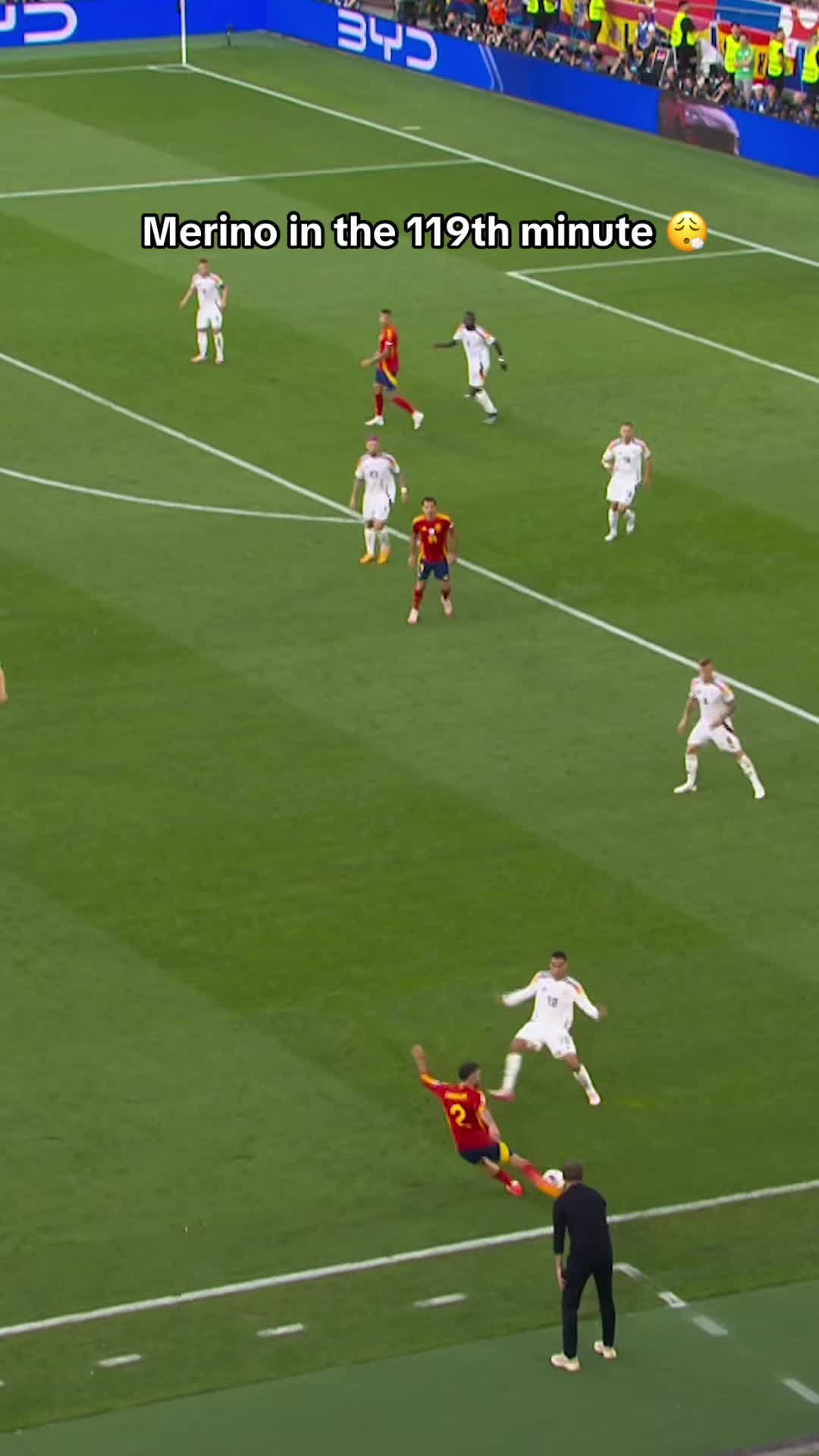
Clutch Merino 😮💨
merino goal today portugal 0-1 spain ronaldo interview today ronaldo retirement retiring
kane goal today kane highlights today england 2-1 congo
 Links
Links
 Contact
 App
App


