



The Vietnam team has a new look for the 2026 ASEAN Cup.



The two-week training camp in South Korea is considered a "test phase" for the Vietnam team to trai n tactics, shape the squad structure, and perfect their gameplay.
The Vietnam team's days of seclusion in Incheon (South Korea) were not merely about physical conditioning. Under the guidance of coach Kim Sang Sik, this was a major overhaul of mindset and operational system. Three wins against "sparring partners" at three different levels helped the Vietnam team gain valuable insights during their preparation for defending the ASEAN Cup title. All three lines of the Vietnam team are relatively stable and cohesive, especially the attack, which scored 10 goals.
Although the results in terms of scorelines from these friendly matches were positive, for the South Korean coach, that was never the top priority during this "foundation-building" phase. Testing themselves against representatives from various tiers of South Korean football allowed coach Kim Sang Sik to evaluate the adaptability of each position to different playing styles. This was a golden opportunity for players to assert their value and compete for starting spots in the official lineup.
Going through three friendly matches against teams from different divisions enabled the coaching staff to make the most accurate quantitative and qualitative assessments of each individual's capabilities. Each opponent, with its unique playing philosophy, forced the Vietnamese players to constantly adjust their approach, from high pressing to proactive counter-attacking defense.
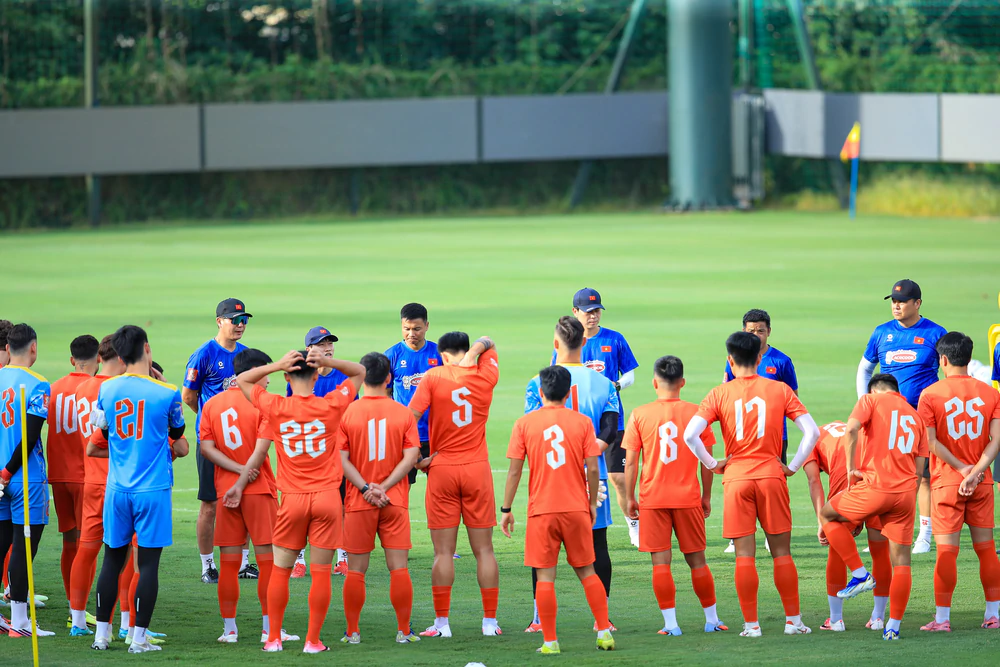
Coach Kim Sang Sik is finalizing the last preparations for the Vietnam team after the training camp in South Korea. Photo: Hoang Linh
Such matches helped coach Kim Sang Sik gain an overall perspective on his players' ability to withstand pressure and operate the system against strong opponents. A deep analysis of recent training sessions shows that coach Kim Sang Sik is focusing heavily on three core elements to shape the playing style of the Vietnam team.
First, the Vietnam team must establish a connected defensive system. This will create cover and maintain team shape when under pressure from the opponent. Next, they need to organize diverse attacks, emphasizing group combinations and exploiting space on the flanks. Along with that, they must achieve the fastest possible transition between phases. This is the key to coach Kim Sang Sik's philosophy. The South Korean coach always demands that the entire team react extremely quickly as soon as they regain or lose possession of the ball.
Besides tactics, this is also a sensitive time regarding personnel. The interweaving of experienced veterans and new talents is being intensively tested. The goal of the coaching staff is to find the best connections, creating a stable framework while still ensuring the potential for breakthroughs.
The highest goal of the Vietnam team is undoubtedly to successfully defend the crown against the strong rise of Indonesia or rival Thailand. Furthermore, the 2026 ASEAN Cup serves as a launchpad for coach Kim Sang Sik to build a solid foundation, aiming for greater goals on the continental stage in the near future. The current confidence and thorough preparation show a Vietnam team that is resilient and ready for any challenge.


Wonderfulshortvideo

messi goal today messi assist today messi highlights vs egypt enzo fernandez goal today romero goal today argentina goals today argentina 3-2 egypt



“Wonderful player, fantastic player, could not run” 😅

Neville, Keane and Wright DO NOT agree on the future of Argentina in the World Cup 👀
“It gave you everything” 👀

Clutch Merino 😮💨
merino goal today portugal 0-1 spain ronaldo interview today ronaldo retirement retiring

kane goal today kane highlights today england 2-1 congo
 Links
Links
 Contact
 App
App


