



World Cup at Home: Asia's Journey Still Has a Long Way to Go



Forty years after their first appearance in Mexico 1986, Iraq's return to the World Cup came via an extraordinary journey: 21 games over 28 months, passing through Basra, Hanoi, Manila, Jakarta, Kuwait City, Seoul, Muscat, Amman, Jeddah, Abu Dhabi, ending with a tense win against Bolivia in Monterrey. However, that entire remarkable campaign fell apart in under two weeks: losing 1-4 to Norway, 0-3 to France, and 0-5 to Senegal, Iraq exited with no points, a -11 goal difference, barely different from the 1986 squad.
The journey may have been many times longer, but the destination remained a door that shut far too quickly. The 2026 World Cup marks the tournament with the largest number of Asian representatives in history, most of whom endured qualifying campaigns not unlike Iraq's. Yet an uncomfortable truth persists: few teams step onto the global stage with enough competitive exposure.
Iraq is the most extreme example—21 qualifying matches, more than any other team worldwide, but the majority of opponents were within the West Asian region. The result is a team battle-hardened... within its own bubble, yet bewildered by the speed and power of Norway or France.
China offers another slice of the same ailment. While playing dozens of matches each year, China has only ever reached the World Cup once (2002, losing all three games without scoring a single goal), proving the issue isn't resources. China has no shortage of money, infrastructure, or even determination—football was once designated a top priority. But their international playing environment is almost entirely confined to the region.
In analyses of Asia's failures, some blunt opinions point to the continent's incredibly fragmented competition system. Southeast Asia has the ASEAN Cup, South Asia the SAFF Championship, West Asia the Gulf Cup, the Arab bloc the FIFA Arab Cup, East Asia the EAFF Championship...
Each sub-region operates its own ecosystem, with little overlap or cross-exposure. The only opportunities come from Asian Cup and World Cup qualifiers, but even those are divided by geographical zones and, at times, combined results from both qualifying rounds.
This fragmentation fails to generate enough competitive pressure to elevate overall standards; instead, it reinforces familiar "safe zones." The situation is even worse at the club level, despite flashy names mimicking Europe's. The massive financial resources of the Saudi Pro League and West Asian clubs create a lopsided playing field, while the rest of the continent still struggles for spots in the Asian Champions League.
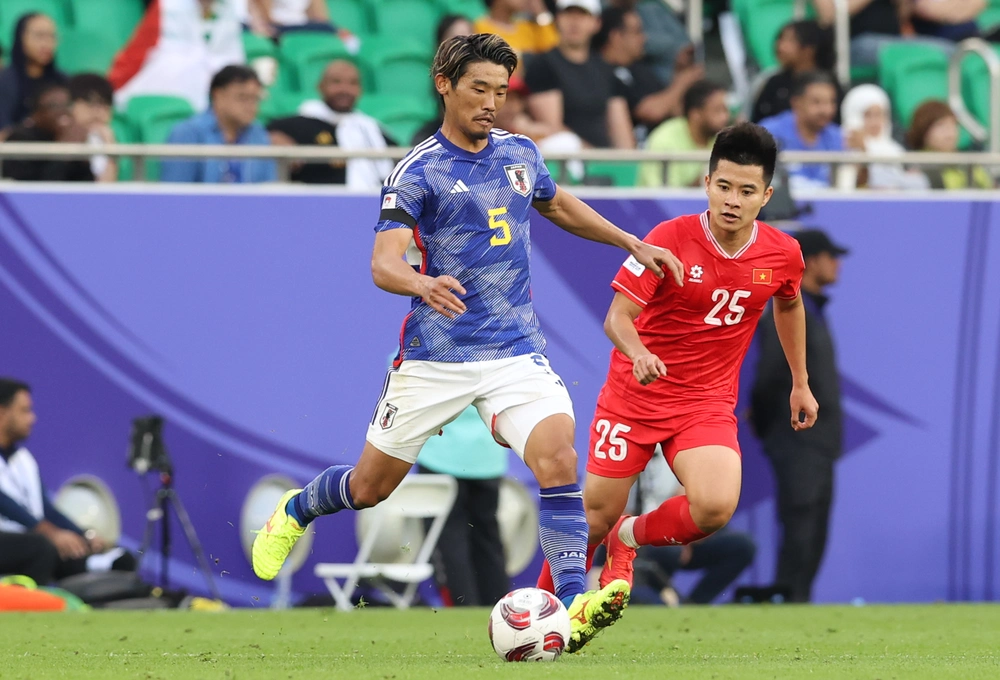
Only when Vietnamese football can regularly export players abroad, as Japan does, can it dream of making an impact at the World Cup. Photo: Hoang Linh
The Asian Football Confederation (AFC) is not unaware of the issue. They are learning from UEFA's Nations League model, turning friendly matches into official, tiered competitions with stakes and relegation, minimizing meaningless games or "spirit miracles." The AFC plans to do the same. The question, however, comes down to geographical and financial hurdles: when will it happen?
Apart from Japan and South Korea—two footballing nations that have persistently sent players abroad for decades—most Asian teams go against that trend. The problem is that the domestic leagues in most Asian countries lack the quality to prepare players for World Cup level, while often serving as retirement homes for past-their-prime stars seeking lucrative contracts. A football culture that simultaneously lacks international exposure for its youth and has insufficient incentive to push its best talent abroad can hardly achieve a qualitative breakthrough.
What does all this have to do with Vietnamese football?
The truth is that Asia's problems persist in Vietnam, as an affected member. We talk a lot about improving the national team, boldly expanding naturalization trends, but still follow a "running in circles" path regarding match quantity, regional tournaments, and foreign player quality.
No factor truly breaks through the safety thresholds. That's why, even if we field a lineup with 5-7 naturalized players, that strength would only be enough to consider maintaining the top spot in Southeast Asia, not to calculate where we might rank on the continent. The foundation for setting goals is too thin, precisely because while there are many matches per year, their value is frequently diluted.
Notably, it is FIFA—not the AFC—that initiated the FIFA ASEAN Cup. The fact that a global body had to directly design an additional regional competition, rather than relying on the continent's existing structures, speaks volumes about the gap left by the AFC. It's a form of "hand-holding" to help Southeast Asian football gain more meaningful matches, breaking out of the self-imposed limits that the regional machinery has yet to solve.
In other words, if Asia's road is still a thousand miles long, then for Vietnamese football, it is "n" times that distance.


Wonderfulshortvideo

messi goal today messi assist today messi highlights vs egypt enzo fernandez goal today romero goal today argentina goals today argentina 3-2 egypt



“Wonderful player, fantastic player, could not run” 😅

Neville, Keane and Wright DO NOT agree on the future of Argentina in the World Cup 👀

“It gave you everything” 👀

Clutch Merino 😮💨

merino goal today portugal 0-1 spain ronaldo interview today ronaldo retirement retiring

kane goal today kane highlights today england 2-1 congo
 Links
Links
 Contact
 App
App


