



World Cup on home soil: Seeing red doesn't mean it's ripe!



Ahead of the 2026 World Cup, numerous upbeat predictions indicated that this event would signify a milestone for Asian soccer. The AFC now has nine teams in the finals for the first time, the highest number in its history.
Japan is seen as a potential surprise package, South Korea and Iran boast experienced squads, Saudi Arabia brings ambition following massive investments, and Australia has consistently proven its ability in recent World Cups. All of this creates a sense that Asia is finally ready to move up to a new level.
The reality, however, is completely different. When the group stage ended, only two Asian representatives advanced, representing just over 22% of the participating teams. Meanwhile, Africa staged a remarkable upset, with nine out of ten teams making it past the group stage—an unprecedented achievement in tournament history.
What is worth pondering is that this accomplishment was not the result of a few surprise matches. It reflects an increasingly clear divergence between the two development models.
Among the two Asian teams that advanced, only Japan truly represents a typical Asian football model. Australia, though a member of the AFC since 2006, has a squad largely comprised of players who grew up in the European football environment. They bring the pace and intensity of European football to their national team. In other words, if Australia is taken out of the equation, Asia's success rests almost solely on Japan's shoulders.
Of course, there is much to say about Japan. But it must still be discussed, because it is the only model capable of making a difference, and most importantly, it is quite relatable to Vietnamese football.
Over the past three decades, Japan is the only Asian football nation to have created a steady development curve. They proactively built an entire training system based on European standards, encouraged players to go abroad early, and regarded the World Cup as a destination rather than a reward.
Since their first World Cup appearance in 1998, Japan has consistently narrowed the gap with the world's top powers. They may not be able to overcome Brazil in the round of 32, but in all international assessments of that match, Japan is placed in a respectable position—a worthy opponent for a five-time world champion.
Just that alone represents a giant leap forward. Meanwhile, most Asian teams have remained stagnant. South Korea, since its semifinal feat in 2002, has only advanced past the group stage once more. Iran has participated in the World Cup seven times but has never made it to the knockout stage.
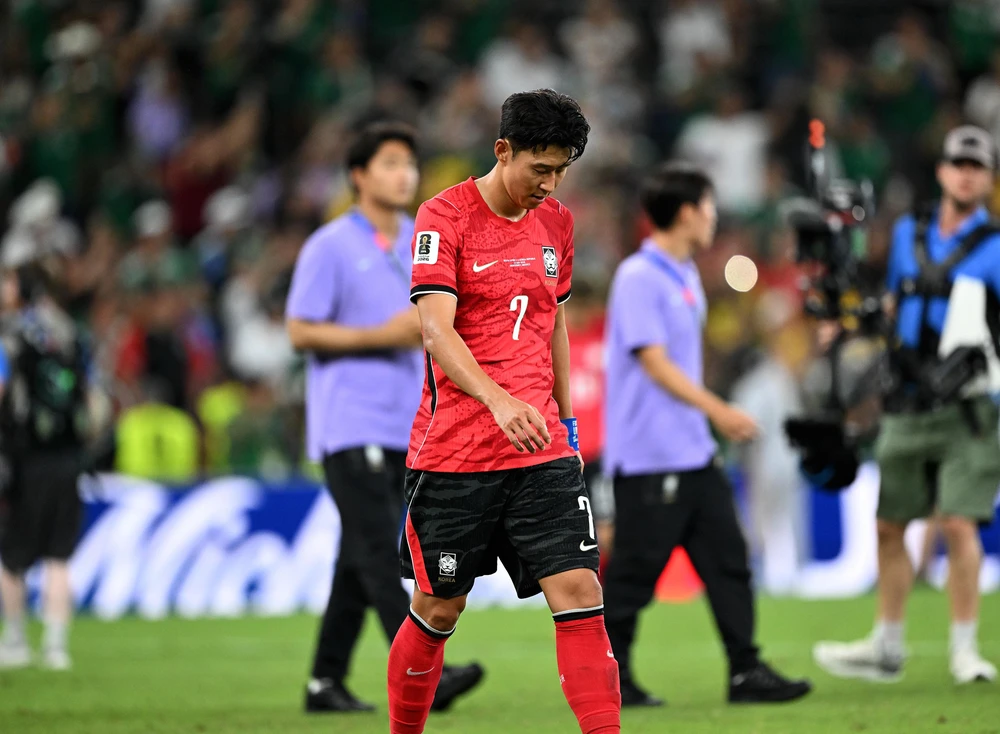
South Korea had to leave immediately after the group stage despite high expectations at the 2026 World Cup. Photo: Xinhua/VNA
Saudi Arabia once shocked the world by defeating Argentina in 2022 and invested billions of dollars in the Saudi Pro League, but their World Cup performance has not seen a breakthrough. Qatar is no different. After winning the Asian Cup and hosting the 2022 World Cup, they have yet to translate their massive investments into real competitiveness on the pitch.
On the flip side, Africa's rise did not come from fleeting inspiration but from a long process of accumulation. However, it would be a mistake to think Africa's success stems solely from the diaspora. South Africa is a team that primarily uses domestic players. More important is the competitiveness. A Moroccan or Senegalese international never gets a guaranteed spot just because of reputation. They have to compete with dozens of other players who play in Europe. It is this constant淘汰 pressure that creates the quality of the national team.
That is precisely what most Asian football lacks. Most domestic leagues still have a lower intensity than World Cup standards. Many clubs rely on foreign players to decide matches, while local players are rarely placed in highly competitive environments. Even Saudi Arabia's move to bring a host of global stars to the Saudi Pro League has not been enough to change the development foundation of local players.
"Seeing red, don't think it's ripe." It sounds quite bitter, but it is a very valuable lens for Vietnamese football to examine itself. Not for us to think about going to the World Cup, but to build a belief in the ability to improve ourselves.
Asia's failure at the 2026 World Cup raises many issues for Vietnamese football. First, are our current efforts sufficient when the gap between us and Asia's top group is still wide?
Second, after this failure, the Asian 'giants' will try harder to improve themselves, meaning the opportunities for the rest will shrink. Have we prepared anything for this scenario? Is there a need to adjust the 2045 vision?
Thus, the 2026 World Cup sends a very clear message to Vietnamese football. Do not confuse the expansion of opportunities with the improvement of standards. FIFA's increase in the number of participating teams brings the World Cup dream closer, but it does not make the path to get there any easier.


Wonderfulshortvideo
messi goal today messi assist today messi highlights vs egypt enzo fernandez goal today romero goal today argentina goals today argentina 3-2 egypt



“Wonderful player, fantastic player, could not run” 😅

Neville, Keane and Wright DO NOT agree on the future of Argentina in the World Cup 👀

“It gave you everything” 👀

Clutch Merino 😮💨
merino goal today portugal 0-1 spain ronaldo interview today ronaldo retirement retiring

kane goal today kane highlights today england 2-1 congo
 Links
Links
 Contact
 App
App


