



From the World Cup to the ASEAN Cup


With the 2026 World Cup showing that the disparity in quality among football countries is shrinking quickly, Southeast Asia is also facing a struggle like never before. For Vietnam, coach Kim Sang-sik recognizes that the ASEAN Cup is now a tough challenge, and the team needs to adapt to maintain its dominance.
A clear reality in Southeast Asian football is that the ASEAN Cup is no longer a competition where Vietnam or Thailand can automatically enter with a superior status as they did many years ago.
The gap is closing fast. Indonesia is the most obvious example. The team from the archipelago has undergone a complete overhaul thanks to the influx of naturalized players from Europe.
Malaysia is also pushing a similar strategy to upgrade its squad quality. The Philippines continues to rely on players raised abroad, while Thailand persists in improving its domestic league and refreshing the national team.
In this context, the Vietnamese team cannot stay static. The 2026 World Cup shows that modern football no longer waits for conservative teams. Lower-ranked sides can spring surprises if they have speed, tactical organization, and strong pressing ability. That also accurately reflects the current state of Southeast Asian football.
Coach Kim Sang-sik is probably the one who sees this change most clearly. Since taking over, the Korean tactician has started a "quiet overhaul" of the Vietnamese national team. He is not building the squad around a few fixed stars as before, but instead focuses on squad depth and constant competition in every position.
That is why many veterans have lost their places even though they were long-time pillars. Coach Kim wants the team to operate in a more modern way—faster, stronger, and more flexible in approaching matches. Versatile players like Xuan Manh, Hoang Hen, Van Khang, Tai Loc, and Dinh Bac are highly valued because they can meet various tactical demands.
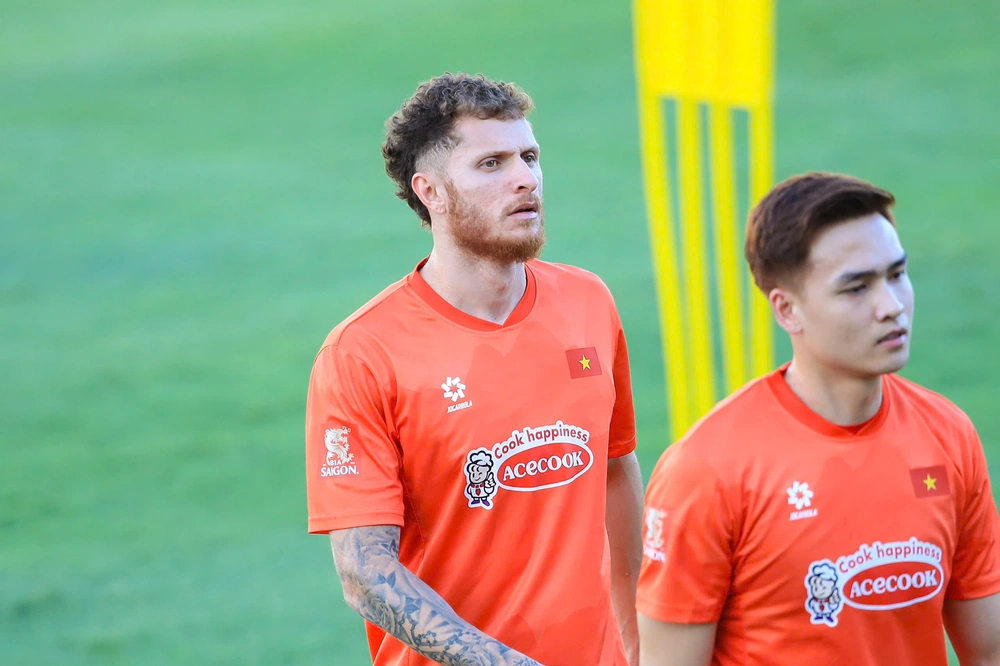
Naturalized players such as Tai Loc (formerly Geovane) bring quality and squad depth to the Vietnamese national team. Photo: Hoang Linh
Notably, the Vietnamese team no longer depends entirely on a fixed core. Coach Kim is striving to create a collective that can rotate continuously while maintaining professional standards. This is also a common trend in modern football, as tournaments become denser and demand higher intensity.
Therefore, the ASEAN Cup is no longer simply a game of technique or experience as before. It is becoming a contest of squad depth, physical fitness, speed, and tactical adaptability.
That is also why the Vietnamese team has become more open to naturalized players. The arrival of Xuan Son, Hoang Hen, and Tai Loc shows that the team is aiming to raise professional standards to a new level. Not only do they strengthen the attack, but they also create greater competitive pressure on domestic players.
On the positive side, this forces Vietnamese players to change if they do not want to fall behind. Regional football has also learned many lessons over the years. And the ongoing 2026 World Cup serves as another reminder for football people in this area.
At this point, coach Kim Sang-sik has also made his players understand that a starting spot on the Vietnamese team is no longer a reward for reputation or past contributions. It will depend on form, adaptability, and how well they fit the coach's tactics.
Perhaps the 2026 World Cup is diverting some fans' attention away from regional football. But for coach Kim Sang-sik, this is a very important period to shape the future of the Vietnamese national team.
The reason is that if they do not change now, the Vietnamese team runs a real risk of being overtaken in a race that is becoming increasingly fierce in Southeast Asia.


Wonderfulshortvideo
messi goal today messi assist today messi highlights vs egypt enzo fernandez goal today romero goal today argentina goals today argentina 3-2 egypt



“Wonderful player, fantastic player, could not run” 😅

Neville, Keane and Wright DO NOT agree on the future of Argentina in the World Cup 👀
“It gave you everything” 👀
Clutch Merino 😮💨
merino goal today portugal 0-1 spain ronaldo interview today ronaldo retirement retiring

kane goal today kane highlights today england 2-1 congo
 Links
Links
 Contact
 App
App


