



Guangzhou Sport University is expected to take over, potentially giving Evergrande Football School a new lease on life.



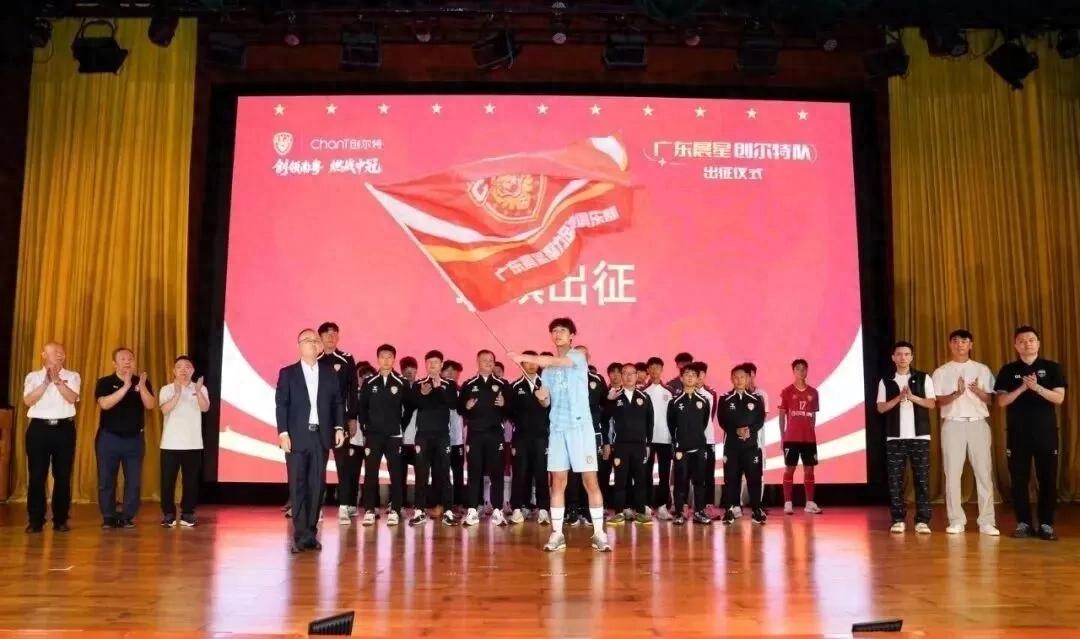
Reporter Wang Wei reports On the afternoon of June 1, the opening match of the Yingde Division of the 2026 CCL Regional Tournament will take place at the Guangdong Yingde National Women's Football Base, between Guangzhou Huangpu Zhicheng and Guangdong Chenxing Juli Chuangert.
Guangdong Chenxing Juli Chuangert is a team formed primarily from Evergrande Football School's talent pool, competing in the CCL this year as they push toward professional league status. Just as the team set off for the CCL, news emerged that Evergrande Football School had entered bankruptcy restructuring judicial proceedings, drawing widespread attention. As the restructuring moves forward, there are indications that Guangzhou Sport University may take over the school, which was founded in 2012 as a high-level private youth football training institution, potentially giving it a new beginning.

Looking back to May 13 this year, the Guangzhou Intermediate People's Court issued a civil ruling, formally accepting the bankruptcy restructuring case of Evergrande Football School and appointing a liquidation team as the restructuring manager. On May 18, the National Enterprise Bankruptcy Restructuring Case Information Network published a public recruitment notice for restructuring investors, revealing the school's insolvency and tight cash flow. Many fans and industry insiders equated "bankruptcy restructuring" with "closure and liquidation," sparking widespread speculation about the school's impending demise.
In reality, bankruptcy restructuring is a judicial procedure designed to rescue struggling enterprises. Its core purpose is not to sell off assets or terminate operations, but to sort out debts, consolidate resources, and attract new investors within the legal framework—helping viable entities overcome difficulties while ensuring the continuity of education, protecting the rights of teachers and students, and preserving business operations.
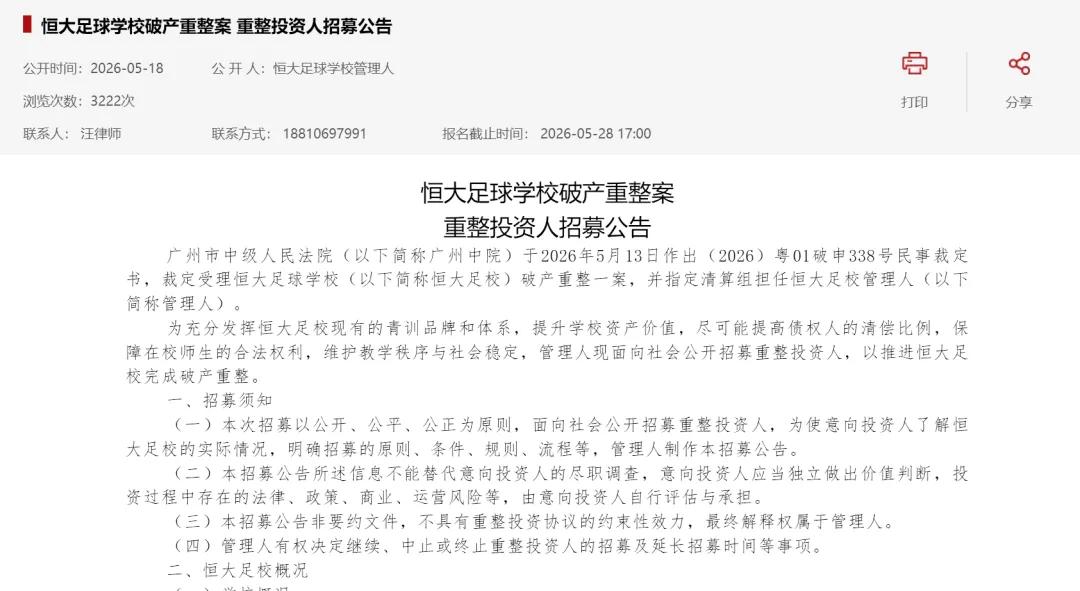
Based on publicly available asset and debt data, Evergrande Football School possesses solid physical infrastructure and irreplaceable youth training value, fully qualifying for restructuring and revival. According to the announcement, as of December 31, 2025, the school's total assets reached 810 million yuan, including fixed assets of 753 million yuan, covering the entire campus land, teaching buildings, dormitories, professional football training fields, and supporting facilities.
It is learned that all land and building property rights of Evergrande Football School are independently registered under the school's name, with clear ownership certificates. This forms the foundation and advantage for its independent restructuring and sustained development.
Currently, even during the special bankruptcy restructuring phase, daily operations have never ceased. On May 22, the school released its 2026 academic year enrollment brochure via its official public account, with recruitment activities proceeding normally and online enrollment livestreams continuing as usual. On the field, the team fully funded and operated by the school—Guangdong Chenxing Juli Chuangert—is ready to go. Composed primarily of students born between 2008 and 2009, the team will debut in the CCL on June 1, aiming to reach the national finals and eventually enter the professional league system.
Over its 14-year history, the school has nurtured many well-known players and national team members, including Xu Bin, Ai Feierding, Huo Shenping, Liu Jiale, Buni Yaming, Wang Gengrui, Aili Nizhaer, Liu Binglin, Zhang Hongfu, Yang Qiandong, and more. Even goalkeeper Qin Ziniu and Jiang Cheng'en, who recently helped the national youth team win the U17 Asian Cup runner-up and qualify for the U17 World Cup, both came from Evergrande Football School.
Since its establishment, a total of 1,138 students have been selected for various national youth echelons. In the 2026 season, 127 former players from the school are competing in domestic professional leagues at all levels. The school has trained tens of thousands of young football enthusiasts and professional prospects, continuously supplying fresh talent for Guangdong football and Chinese football as a whole.
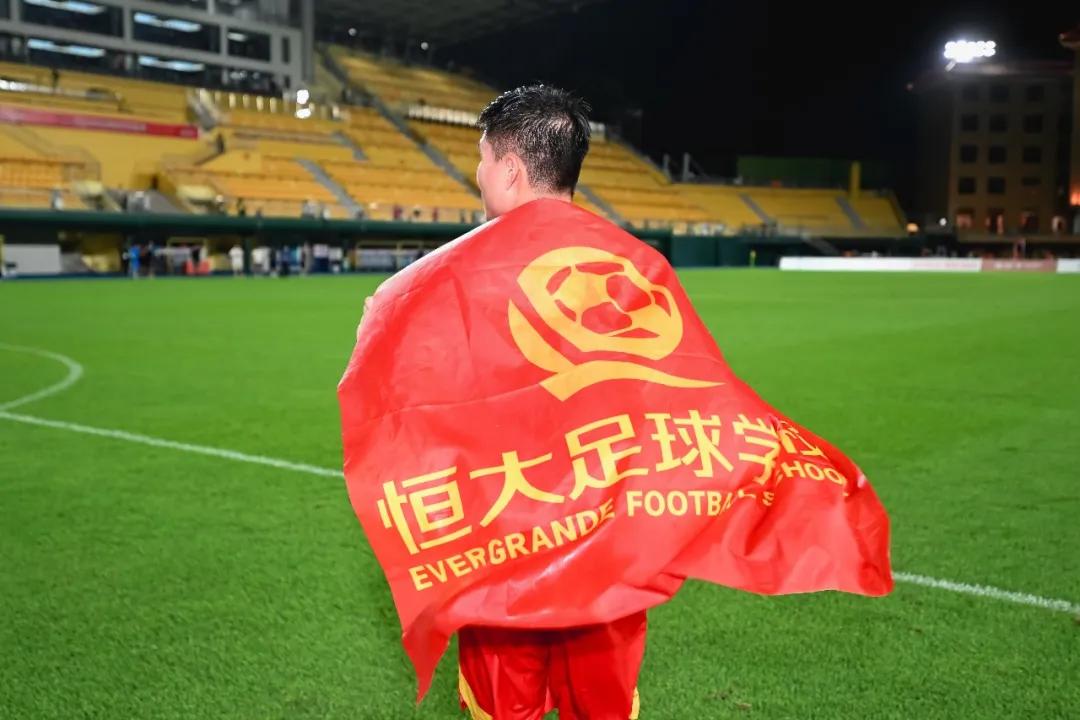

Behind these impressive achievements, hidden problems have gradually emerged. The parent company's collapse ultimately plunged the school into financial crisis. Prior to this, several organizations had extended cooperation offers, including the provincial tourism and hospitality system, and the Guangdong Provincial Sports Bureau and Guangdong Football Center had also communicated with the school multiple times, though no concrete progress was made later.
Recently, the possibility of Guangzhou Sport University taking over has grown louder. For the school, a partnership with Guangzhou Sport University would mean far more than just a change in operator—it would represent a comprehensive upgrade in educational models and talent cultivation systems. Currently, Evergrande Football School holds complete licensure for regular primary, junior high, and senior high schools, operating a parallel model of "academic courses + football training." If it leverages the resources of Guangzhou Sport University in the future, the school could add a secondary vocational school license while retaining its current high school qualification, creating a dual-track system of "regular high school + vocational school." On this basis, establishing a 3+4 integrated talent cultivation pathway that connects primary, secondary, vocational, and undergraduate education would be an excellent choice.
From a resource complementarity perspective, Guangzhou Sport University and the football school represent a powerful alliance. Evergrande Football School boasts a 14-year youth training system, an experienced coaching team, and nationally top-tier football training grounds and living facilities, making it an ideal platform for youth football practice.
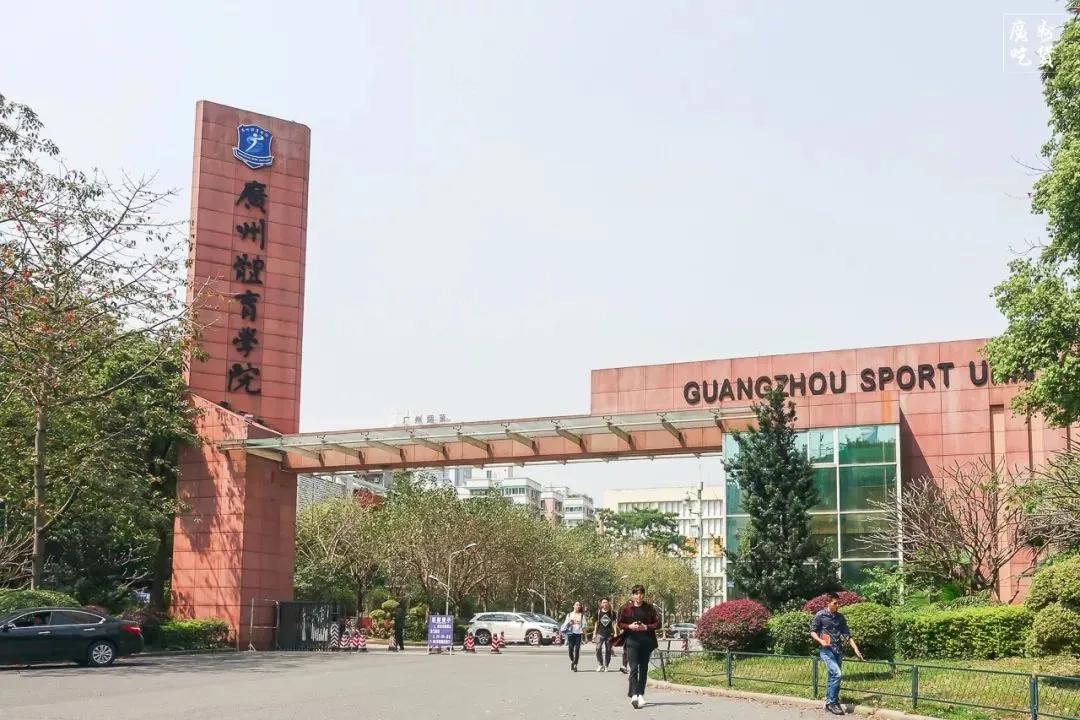
As a public sports undergraduate institution, Guangzhou Sport University possesses professional sports teaching and research teams, a mature higher education management system, well-established academic advancement channels, and official resource endorsements, providing strong support for the school's standardized operations, teaching research upgrades, and teacher training. After the combination, Evergrande Football School can shed its dependence on private capital and rely on the stable system of a public institution for long-term operations.
In turn, Guangzhou Sport University can utilize the large-scale youth training base to address its own shortages in professional football training venues and grassroots practice platforms, promoting the integration of industry, academia, and research in college sports programs—ultimately achieving mutual empowerment and win-win outcomes.
Based on current understanding, "stability" is the primary principle of bankruptcy restructuring. Teachers and students have expressed their thoughts: "First, stability in the status of faculty and students—ensuring all students on campus attend classes and train normally, and securing the positions of staff and coaching teams; second, stability in the youth training system—preserving the existing echelon structure, training philosophy, and development model to avoid a talent gap; third, stability in school operations—steadily advancing daily tasks such as enrollment, teaching, and competitions."
From a practical standpoint, a public sports institution taking over a private educational organization is a completely new cooperation attempt, with many real-world challenges yet to be resolved: how to integrate management between two different types of educational entities and establish a compliant and efficient operational mechanism currently lacks a clear plan; personnel placement—including whether existing teachers, staff, and football coaches stay or leave—remains an unsolved issue; furthermore, supporting tasks such as approval of secondary vocational qualifications, policy alignment for the 3+4 integrated pathway, subsequent operation of the Guangdong Chenxing Juli Chuangert team, and expansion of professional channels for young talents require multi-departmental coordination and gradual implementation.


Wonderfulshortvideo
messi goal today messi assist today messi highlights vs egypt enzo fernandez goal today romero goal today argentina goals today argentina 3-2 egypt



“Wonderful player, fantastic player, could not run” 😅

Neville, Keane and Wright DO NOT agree on the future of Argentina in the World Cup 👀

“It gave you everything” 👀
Clutch Merino 😮💨
merino goal today portugal 0-1 spain ronaldo interview today ronaldo retirement retiring

kane goal today kane highlights today england 2-1 congo
 Links
Links
 Contact
 App
App


