



Coffee of the week: The perfect revenge of Pep Guardiola



To start talking about Pep Guardiola's complete transformation of global football over the past 25 years, one should begin at the point when Guardiola, then thirty, departed from his heart club, Barcelona.
1. It was a farewell filled with sighs. When the final whistle blew at Camp Nou on June 24, 2001, Barcelona had been eliminated by Celta Vigo from the Copa del Rey after two-legged semifinals. The 1-4 aggregate defeat ended two trophy-less seasons for the Catalan club.
And more notably, it seemed to confirm a "rumor" that had spread like wildfire in Europe at the time: Intelligent midfielders lacking physical strength, like Pep Guardiola, were outdated.
At that time, the common model for top European clubs was a "pincer" midfield with two defensive midfielders strong in both power and fighting spirit, such as the pairs Albelda-Baraja (Valencia), Vieira-Petit (Arsenal), Davids-Conte (Juventus). Pep was a smart passer extremely sensitive to tactical positions, but he and players like him were no longer the preferred choice for big clubs.
Pep went to Italy to play for Brescia, a mid-table club. When Roma wanted to sign him, manager Fabio Capello even blocked the move because he believed Pep was too weak to survive in a football environment with little space like Serie A. The player he wanted was Juventus's Edgar Davids, not Guardiola.
In reality, Capello greatly respected his pupil's intelligence: "There are many players who talk a lot but say nothing, while Guardiola always finds the right things to say," he noted. But from a sporting perspective, he believed the era of technical midfielders like Guardiola was over.
No drama occurred from then until the end of Pep's playing career: Capello decided to push Guardiola out during the January 2002/03 transfer window, to make room for the rising young midfielder Daniele De Rossi, who was stronger, tackled more, and had more fighting spirit.
Pep quietly went to Qatar to play for Al Ahli in Doha after agreeing to leave Brescia in the summer, then drifted all the way to Mexico, where he played 10 matches for Dorados de Sinaloa before retiring in 2006. The world was right: Guardiola's time was up.
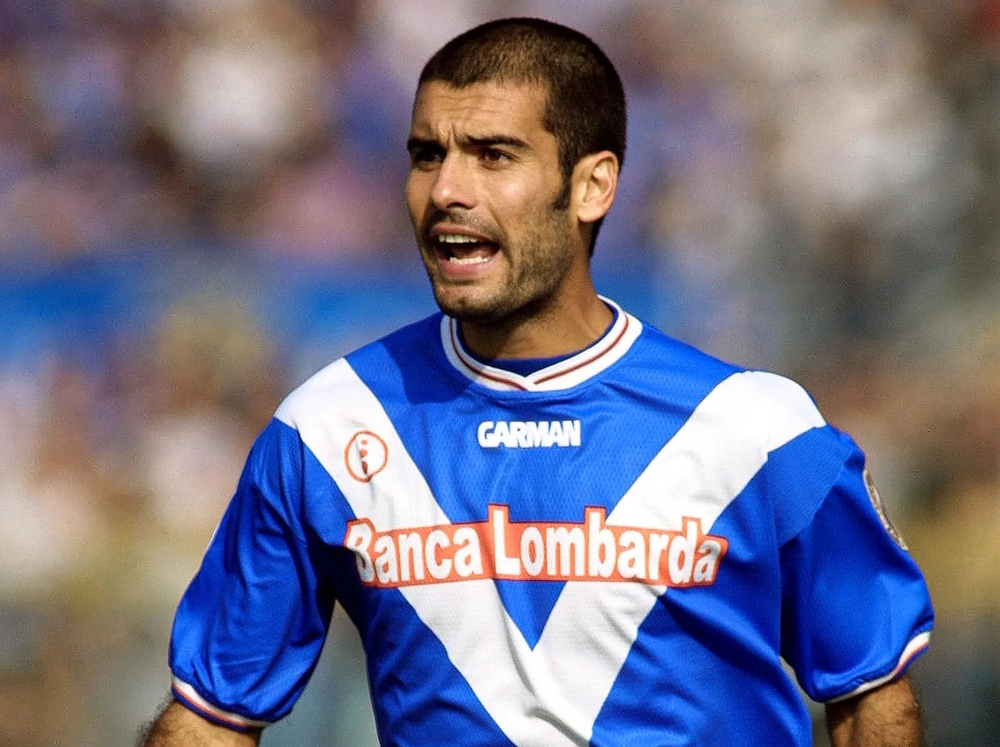
Pep Guardiola is not just a coach, but also a great revolutionary of ideas. Photo: Getty
2. When Guardiola arrived at Man City in 2016, experts probably chuckled: His trademark playing style was too foreign to the typical style of English football.
Lots of collisions, most players are tall and strong, good at heading, referees often overlook unclear fouls, very high pace, and a high frequency of long balls. That's English football.
And Pep? He succeeded at Barcelona and left his mark at Bayern with a positional play style, developing short passes from the back. His preferred players were all small, agile, but seemed too physically weak to perform well in the Premier League.
But as he prepares to leave, after 10 years, 6 Premier League titles, 5 League Cups, 3 Community Shields, 3 FA Cups, the Premier League points record, and one Champions League title, most English clubs have been "reverse-influenced": His tactics have been copied not only in England, with attacks built up from the goalkeeper, full-backs moving into midfield, and small but highly technical midfielders with positional awareness in the middle.
3. Recall the moment he took charge at Barca: One of Guardiola's first radical reforms, besides requiring the goalkeeper to handle and distribute like a midfielder, was to eliminate muscular midfielders like Yaya Toure, in favor of players similar to himself, such as Sergio Busquets, Xavi, Iniesta.
This change even made Toure, one of the best box-to-box midfielders in the world at that time, so angry that he accused Pep of being racist and having issues with black players.
That was also a very risky change, because Toure was an absolutely safe option anywhere in midfield: He had top-class level, good passing and shooting, excellent defense, and physicality that could overwhelm anyone.
But Pep proved he was right, and from then on, football history was bent once again: Midfielders like Pep made a comeback, after more than a decade of decline. From the idea of a man who had been dismissed by history once, as a player.
There is no sweeter revenge than that: You change the flow of the sport, from the lowest position, of a man who was cast out by the system. So perhaps Pep's remark as his City tenure ends was not a joke: "I'm enjoying myself to death." Looking back, he sees a memorable period of football history that has changed dramatically, stemming from the fury of one man, Pep Guardiola.


Wonderfulshortvideo

User ceshi has posted a video.


User soccer has posted a video.
real madrid news today barcelona news today la liga news today lamine yamal goal today lamine yamal assist
WHAT A WEEKEND for Godolphin
It’s like watching the Mona Lisa being painted 🤯
Valid crash out‼️
haaland goal today haaland edit haaland injury news haaland vs ipswich man city 3-2 ipswich town
 Links
Links
 Contact
 App
App