



Which squad should Coach Kim Sang Sik select for ASIAD 2026?



Coach Kim Sang Sik's consideration of adding experienced players to the U21 squad for ASIAD 2026 has sparked intense debate. Should we prioritize immediate objectives or long-term strategy?
1. Initially, the Vietnam Football Federation's plan was quite clear: build a new U23 generation with a core of U21 players (born in 2005 or later), targeting SEA Games 2027, Olympic 2028 qualifiers, and ultimately World Cup 2030. ASIAD 2026 was thus viewed as a "launching pad" for this generation to accumulate experience.
However, the unconvincing performance of Vietnam's U21 team at CFA Team China 2026 (two losses, one draw, finishing last) raised concerns. An inexperienced, battle-tested squad entering a continental-level competition like ASIAD could easily fall into a state of collapse. This reality forced Coach Kim Sang Sik to consider adjustments: calling up quality U23 players like Dinh Bac, Van Khang... to enhance competitiveness. This is a pragmatic reaction—but also understandable.
Bringing in senior players offers clear benefits. Firstly, it improves technical quality. Players who have competed at higher levels help the team operate more steadily, reduce mistakes, and increase competitiveness. More importantly, they serve as "guides," helping young players not be overwhelmed by the pressure of a major tournament. From another perspective, this also protects Vietnam football's image. ASIAD is not a friendly stage but an official continental arena. A poor result could affect the psychology and confidence of an entire generation of players.
However, the downside of this choice is significant. When U21 players' playing opportunities shrink, the process of accumulating experience, the core initial goal, will be disrupted. Worse, relying on older players could leave the future U23 team in a state of "force depletion" when entering official tournaments.
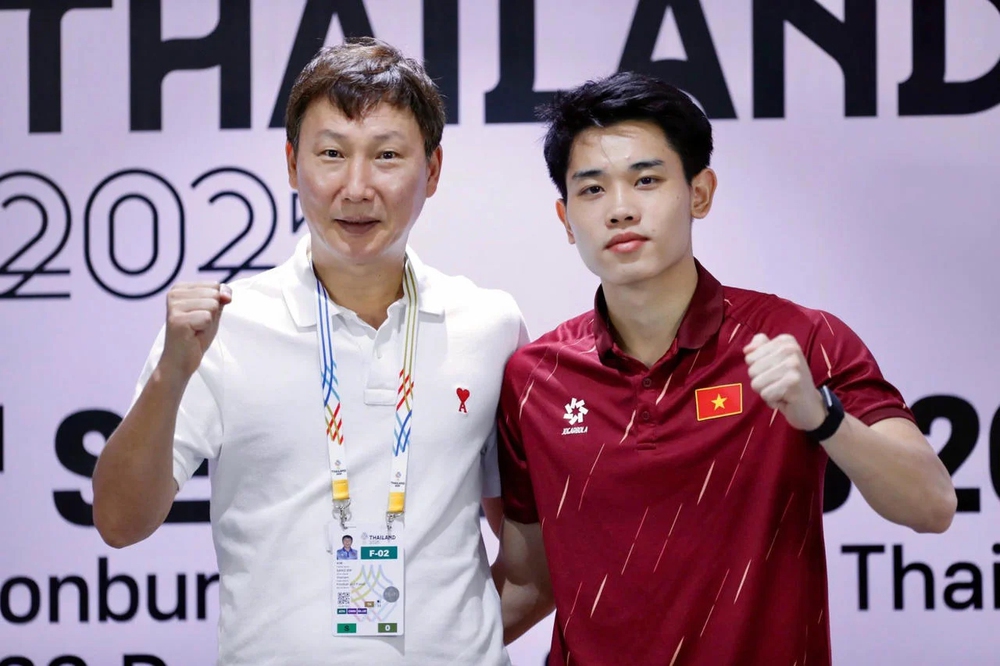
Coach Kim Sang Sik wants to bring Dinh Bac to ASIAD 2026. Photo: VFF
Additionally, there is the issue of overlapping squad commitments. ASIAD 2026 coincides almost entirely with FIFA ASEAN Cup, making it difficult for Coach Kim Sang Sik to directly manage both fronts. The best players thus must "split duties," increasing risks of overload and affecting performance.
2. In this context, extreme choices—either sticking entirely with the U21 squad or heavily "upgrading" it—both carry risks. Keeping the U21 lineup ensures long-term strategy but sacrifices potential failure in results. Conversely, prioritizing immediate outcomes by maximizing reinforcements could lead to better performance at ASIAD but would derail the development of an entire generation.
The most reasonable solution, therefore, lies in balance. The U23 squad for ASIAD should retain most of the U21 framework—the future of Vietnam football—while supplementing a few experienced players as permitted by regulations. These "anchors" not only elevate team quality but also help young players learn in a real competitive environment.
Parallel to this, there must be clear role division within the coaching staff. If Coach Kim Sang Sik prioritizes the national team for FIFA ASEAN Cup, he could delegate leadership of the U23 team at ASIAD to a capable assistant.
Conversely, if ASIAD is identified as the key target, direct command is also worth considering. Coach Kim Sang Sik faces a classic modern sports management dilemma: balancing present and future. Therefore, the optimal choice is not "absolute youthification" or "absolute pragmatism," but a flexible strategy: sufficiently pragmatic to avoid failure, yet sufficiently steadfast not to lose the future.


Wonderfulshortvideo
Ganglion cyst removed


Ganglion cyst removed
User SportScoop has posted a video.
User SportScoop has posted a video.
Replying to @Computer says no.
Replying to @Computer says no.
User SportScoop has posted a video.
 Links
Links
 Contact
 App
App


