



What opportunities exist for Vietnam's U20 women's team to advance to the quarter-finals of the Asian Cup?



After defeating Bangladesh in the last match, Vietnam's U20 women's team continues to hold an opportunity to qualify for the quarter-finals of the 2026 Asian Women's U20 Cup. But in which scenarios will we advance?
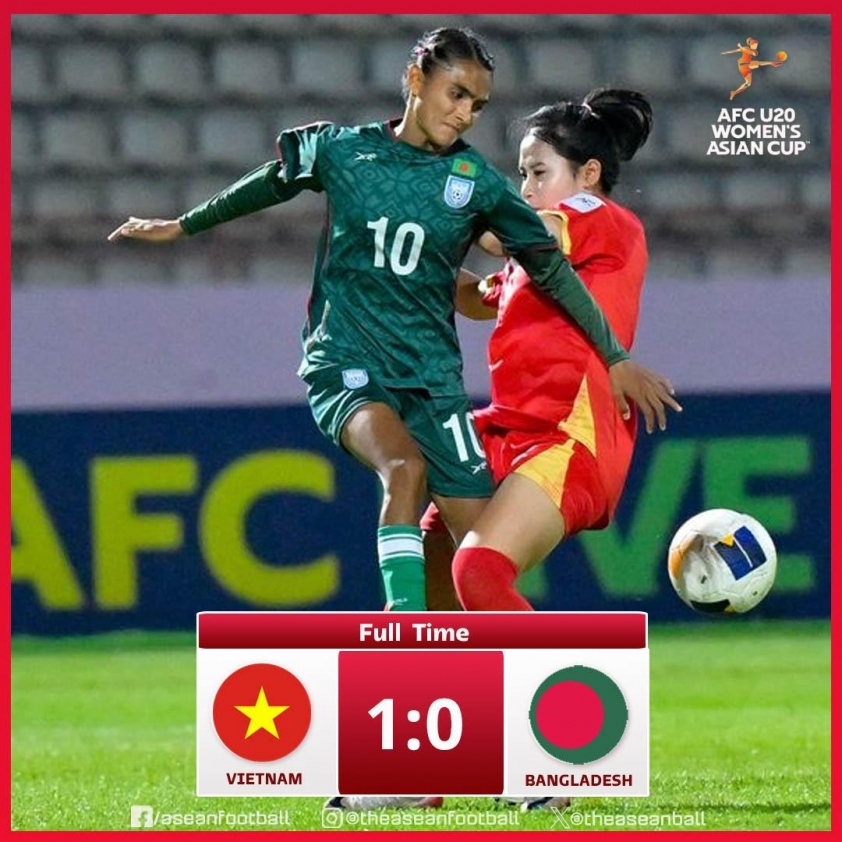
The minimum victory over Bangladesh in the final match keeps Vietnam's U20 women's team hopeful of progressing in the 2026 Asian Women's U20 Cup finals, even though the team cannot compete for the top two positions in Group A. This makes the situation for securing a quarter-final spot more complex, as coach Okiyama Masahiko and his team must await results from other groups to determine their fate.
After the group stage concluded, Group A has officially ended. China's U20 women's team won all three matches to claim the top position with a perfect 9 points. Host Thailand's U20 women's team placed second with 6 points and also secured direct entry to the quarter-finals. Vietnam's U20 women's team ranked third with 3 points, while Bangladesh's U20 women's team finished last in the group and were eliminated. Despite being only third, the 1-0 win over Bangladesh remains particularly significant for Vietnam's U20 women's team, as this result allows the team to maintain a chance of reaching the knockout stage.
According to the tournament format, the third-place teams from the three groups will be compared based on performance to select the two best teams for the quarter-finals. Currently, Vietnam's U20 women's team temporarily leads this group with 3 points and a goal difference of -5. The direct competitors are Taiwan's U20 women's team (Group C) and Uzbekistan's U20 women's team (Group B), both have not earned any points after two matches, but still have opportunities to reverse the situation in the final match.
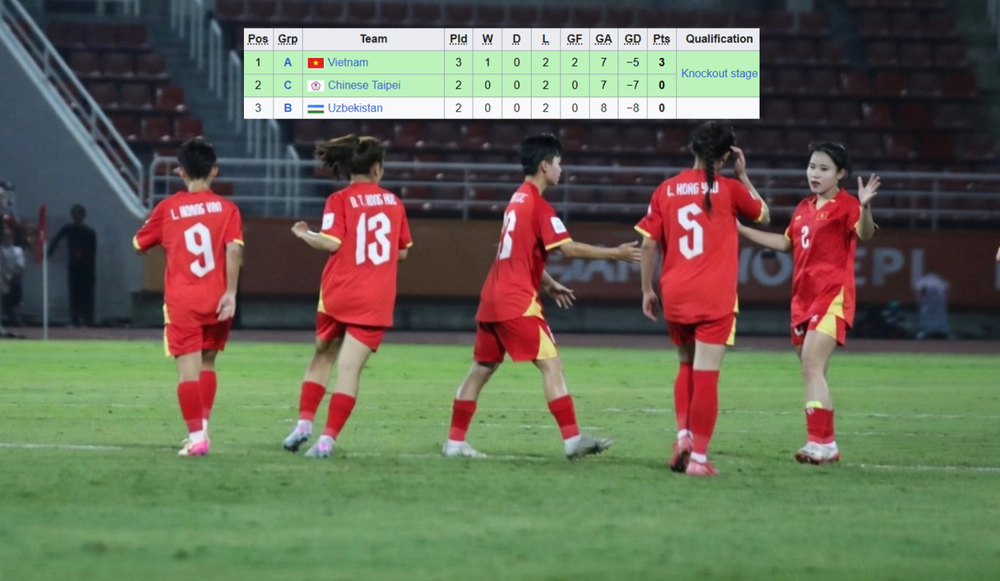
Vietnam's U20 women's team has multiple opportunities to advance to the quarter-finals of the 2026 Asian Women's U20 Cup
In theory, both Taiwan's U20 women's team and Uzbekistan's U20 women's team could surpass Vietnam's U20 women's team if they achieve victories with a sufficiently large margin. However, the advantage in goal difference currently leans toward the Southeast Asian representative. Taiwan's U20 women's team currently holds a goal difference of -7, meaning they must defeat the bottom-ranked team, India's U20 women's team (goal difference -11), by a minimum margin of 3 goals to achieve a better goal difference than Vietnam's U20 women's team. Meanwhile, Uzbekistan's U20 women's team faces even greater disadvantage with a goal difference of -8. The Central Asian team must defeat Jordan's U20 women's team (goal difference -9) by a margin of at least 4 goals to obtain a better goal difference than Vietnam's U20 women's team.
The worst scenario for Vietnam's U20 women's team would occur if both Taiwan's U20 women's team and Uzbekistan's U20 women's team achieve substantial victories in the final match, with winning margins of at least 3 and 4 goals respectively. In that case, these two teams would rise above Vietnam's U20 women's team in the ranking of third-place teams, and Vietnam's U20 women's team would be eliminated.
If both Taiwan's U20 women's team and Uzbekistan's U20 women's team do not win, or if one of these teams does not win in the final match, then Vietnam's U20 women's team will secure a spot in the quarter-finals. If both Uzbekistan and Taiwan win but only by a margin of 1 goal, or if one of these teams wins by only a 1-goal margin, Vietnam's U20 women's team will also advance to the quarter-finals.
If Uzbekistan wins by a 3-goal margin and Taiwan wins by a 2-goal margin, these two teams would also have a goal difference of (-5), matching Vietnam's U20 women's team. In that situation, the three teams would need to be compared further based on other criteria such as goals scored, disciplinary points, or drawing lots.


Wonderfulshortvideo
Ganglion cyst removed


Ganglion cyst removed
User SportScoop has posted a video.
User SportScoop has posted a video.
Replying to @Computer says no.
Replying to @Computer says no.
User SportScoop has posted a video.
 Links
Links
 Contact
 App
App


