



What lineup will the Vietnamese team use against Malaysia?



Having already secured qualification, Coach Kim Sang Sik is expected to field a lineup focused on attack to ensure Vietnam achieves a commanding win against Malaysia at Thiên Trường Stadium on March 31.
Will Coach Kim Sang Sik deploy an ultra-attacking lineup for the Vietnamese team?
Malaysia's forfeit helped Vietnam achieve its qualification goal early. This makes the match on March 31 more about testing tactics and asserting dominance rather than focusing on points.
Instead of the usual cautious approach, Coach Kim Sang Sik is likely to opt for a more proactive and open style. A dominant performance with many goals would not only boost the team's morale but also send a strong message ahead of upcoming major tournaments.
In the recent friendly match, Vietnam operated a flexible 3-4-2-1 formation. Players like Phạm Tuấn Hải and Nguyễn Hai Long made notable impacts in attack. Notably, Đỗ Hoàng Hên's debut provided positive signals. This midfielder moved dynamically, connected well with the forwards, and showed significant synergy with Nguyễn Xuân Son—a familiar partner from club level.
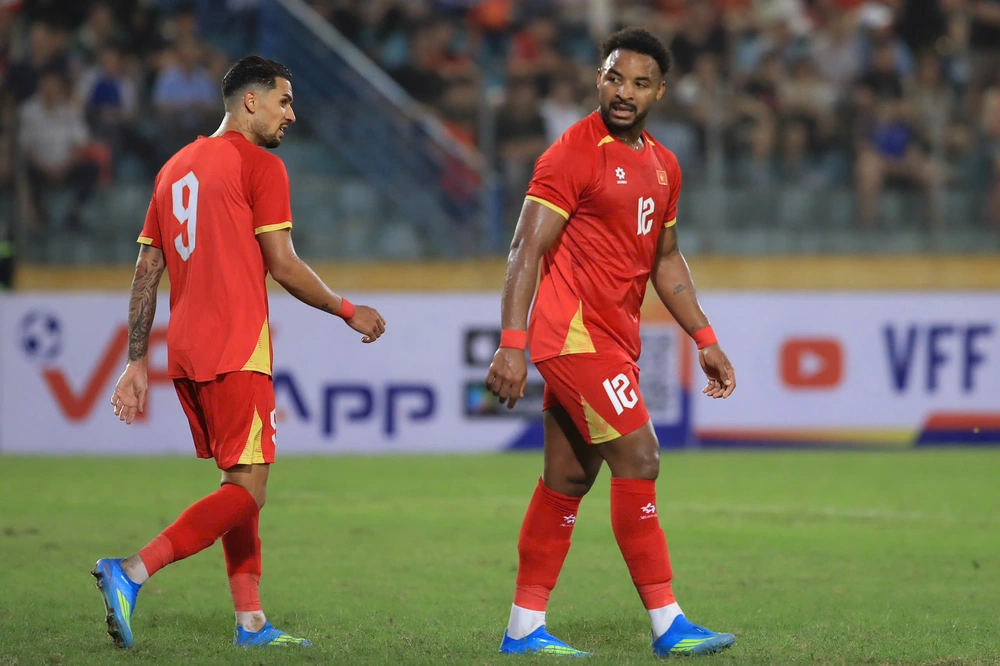
Hoàng Hên and Xuân Son are likely to start from the beginning. Photo by Hoàng Linh
In midfield, the duo Nguyễn Hoàng Đức and Nguyễn Quang Hải continued to demonstrate their role as "conductors," both orchestrating play and ready to unleash dangerous long-range shots. However, the match also revealed some limitations, such as not fully optimizing opportunities, which the coaching staff surely wants to improve against stronger opponents like Malaysia.
An extremely powerful "firepower" setup for the ultra-attacking plan
The most notable aspect of Coach Kim Sang Sik's squad selection is the inclusion of numerous attack-oriented players. On the forward line, Nguyễn Xuân Son remains the biggest hope. Hoàng Hên's presence adds more combination options, especially since the two have shown strong synergy in the past. It would be no surprise if this pair starts against Malaysia.
The wings also feature players with speed and breakthrough ability like Tuấn Hải, Hai Long, and Khuất Văn Khang. This allows Vietnam to deploy diverse attacks, from central routes to the flanks. However, Khuất Văn Khang suffered an ankle injury against Bangladesh, so his availability remains uncertain.
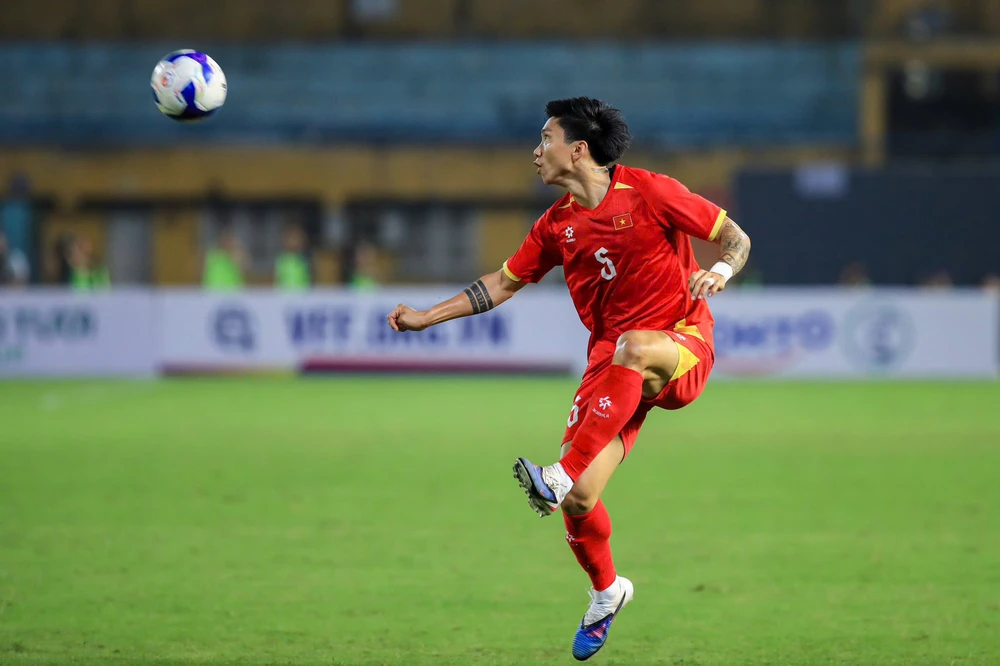
Đoàn Văn Hậu can deliver powerful long-range shots and aerial threat. Photo by Hoàng Linh
Not limited to the forward line, the defense also contributes significantly to the attack. Players like Đỗ Duy Mạnh and Bùi Hoàng Việt Anh are dangerous in set-piece situations. Meanwhile, Đoàn Văn Hậu's return brings powerful long-range shots from the second line. Notably, Nguyễn Văn Vĩ—a defender with impressive scoring ability—could become a "surprise attacking weapon" when pushing forward.
Expected lineup for Vietnam against Malaysia
Goalkeeper: Nguyễn Filip
Defenders: Văn Hậu - Duy Mạnh - Việt Anh
Midfielders: Văn Vĩ - Hoàng Đức – Quang Hải – Tiến Anh
Attacking midfielders: Hai Long - Hoàng Hên
Forward: Xuân Son
With the available personnel, the 3-4-2-1 formation is likely to remain, but with a stronger tendency to push the lineup higher.
In this setup, almost all positions are capable of joining the attack. The two wing-backs push forward continuously, the two attacking midfielders operate freely behind the striker, while the midfield is ready to shoot from distance. If more pressure is needed, Coach Kim Sang Sik could even switch to a 3-5-2 or add another striker, turning the formation into a true ultra-attacking setup.
Even without pressure regarding the result, the match against Malaysia remains important. This is not only a tactical rehearsal but also an opportunity for Vietnam to assert its regional standing. A decisive victory with a dominant attacking performance would be a strong statement as the team aims for bigger goals like the AFF Cup 2026 or World Cup 2030 qualification.
In that context, deploying an ultra-attacking lineup is not only a reasonable choice but also something fans can fully expect from Coach Kim Sang Sik.


Wonderfulshortvideo
Arsenal goal today arsenal 2-1 chelsea arteta interview arteta press conference


The movement is electric ⚡️
Mbappe injury mbappe surgery real madrid 0-1 getafe mbappe return date mbappe edit
ronaldo almeria ronaldo buying new club ronaldo owner ronaldo manchester united owner
de bruyne edit de bruyne passing kdb edit kdb passing highlights rodrygo kevin de bruyne neymar kevin de bruyne
Never gives up 💪
tottenham relegation tottenham relegated
 Links
Links
 Contact
Address:UNIT 1804 SOUTH BANK TOWER, 55 UPPER GROUND,LONDON ENGLAND SE1 9E
Number:+85259695367
E-mali:[email protected]
 App
App


