



The 7th place in the Premier League also has a chance to play in the Champions League! Manchester United aims to secure third place and strive for second, Carrick's preparation plan revealed.



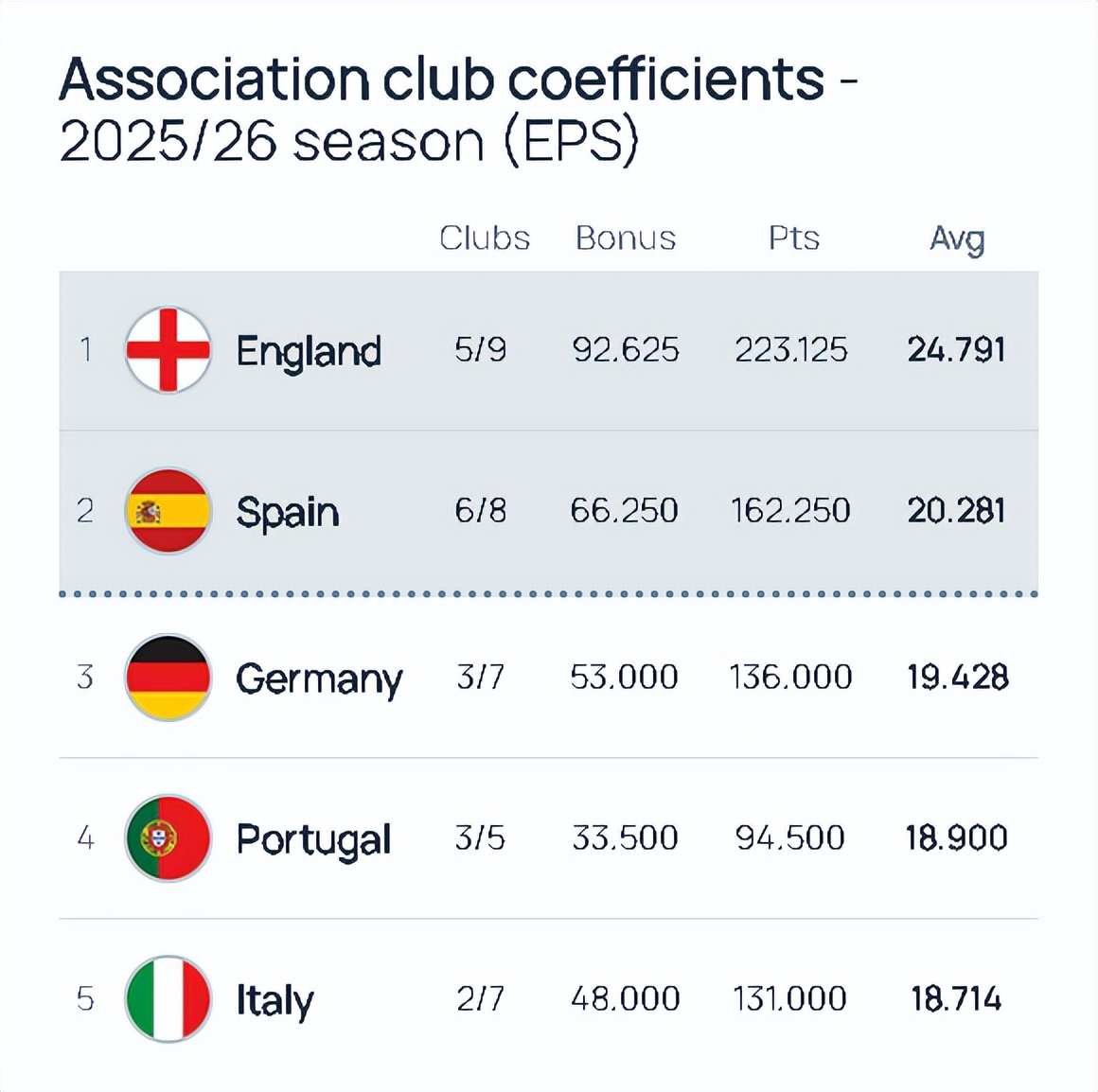
Manchester United's qualification for the Champions League next season is almost certain. Although four Premier League teams were eliminated in the first round of the Champions League knockout stage, the EPS association club coefficient of 24.791 points still leads significantly, with La Liga at 20.281 points ranking second, and Germany only at 19.428 points in third place. Given the Premier League's substantial advantage and five teams still competing in the three major European cups, England's fifth Champions League spot is readily achievable.
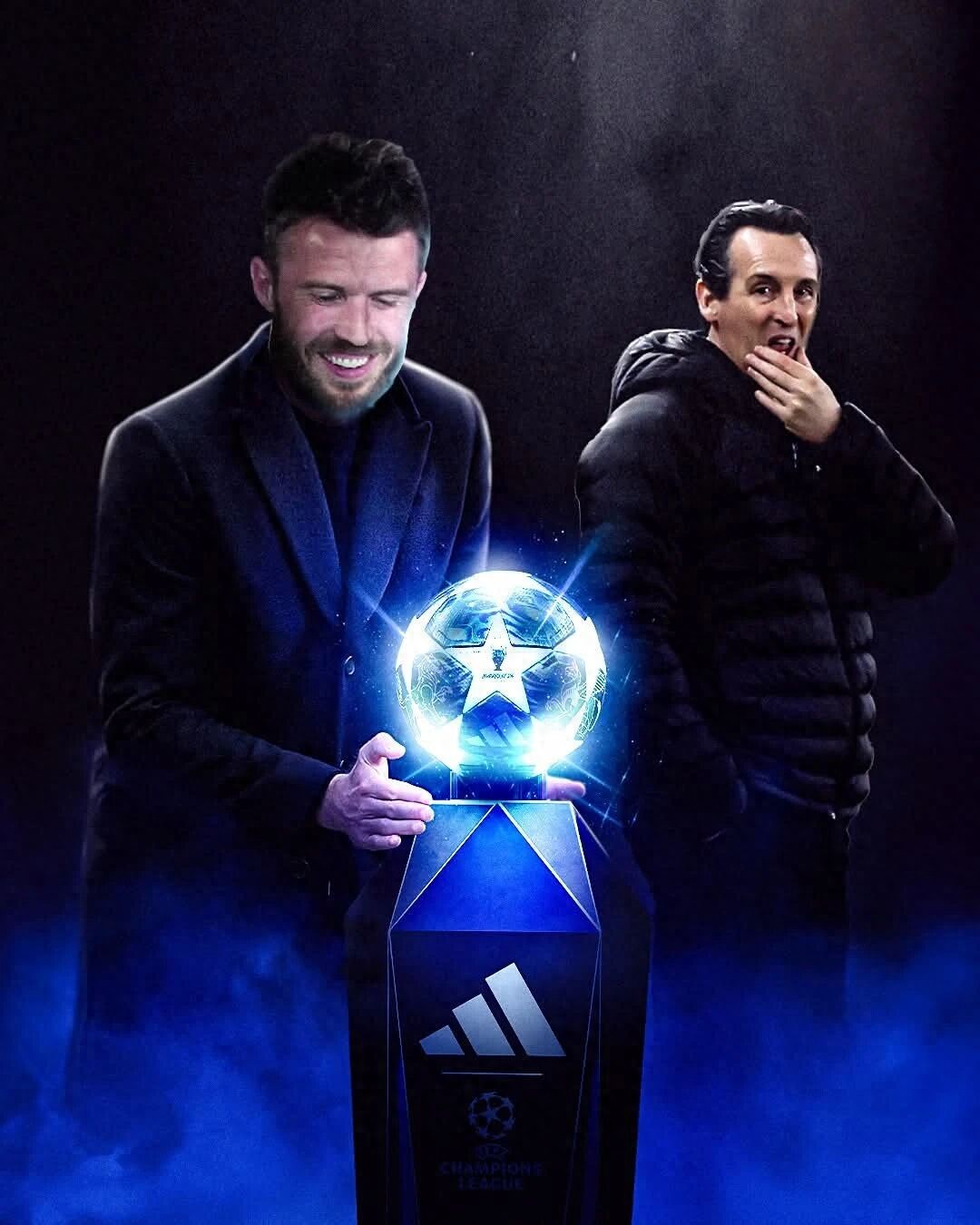
The term "fifth" Champions League spot is actually inaccurate. Traditionally, the top four teams in the Premier League have qualified for the Champions League, hence the habitual reference to a fifth spot. In reality, the top two leagues in the UEFA coefficient rankings receive an "additional" entry, which could be for the fourth team or even the seventh!
In extreme scenarios, the Premier League could potentially have up to seven teams participating in the Champions League next season, meaning even the seventh-place team might enter the Champions League. Of course, that requires very stringent conditions; it is not impossible but has a low probability of realization.
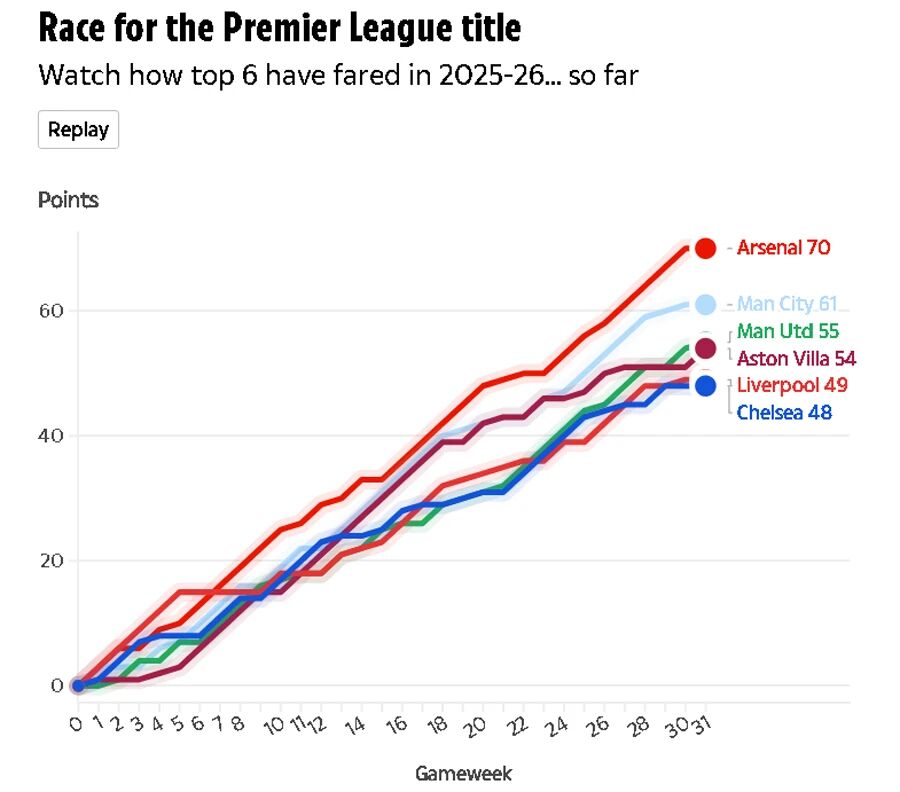
Under current circumstances, the top five teams in the Premier League are assured of Champions League participation, currently occupied by Arsenal, Manchester City, Manchester United, Aston Villa, and Liverpool. However, teams outside the top five like Chelsea, Everton, Brentford, and even Fulham and Brighton haven't given up hope, as they are only 6 points behind Liverpool, with seven matches left to potentially overtake them.
As mentioned earlier, even finishing seventh in the Premier League could theoretically lead to Champions League entry. This depends on Liverpool's performance in the Champions League, Villa's in the Europa League, and their final league standings.
Liverpool and Arsenal are the only two Premier League teams remaining in the Champions League. According to regulations, the Champions League defending champion automatically qualifies for next season regardless of their league position. If Liverpool finishes sixth in the Premier League but wins this season's Champions League trophy, they would still be able to compete in the Champions League.
The Europa League champion also secures a Champions League spot for the next season, similar to Tottenham this season. If Villa wins the Europa League trophy and drops to fifth place in the Premier League, they would directly enter the Champions League group stage as Europa League champions.
Returning to the earlier point, the top two leagues in the EPS rankings receive an additional Champions League spot. The Premier League originally has four spots; if Villa, as fifth place, enters via Europa League victory, and Liverpool, as sixth place, enters via Champions League victory, the additional spot would then be passed to the seventh-place team in the Premier League.
Even if Liverpool and Villa's positions were reversed, this outcome would remain unaffected. However, if both teams finish within the top four, the Champions League spot earned through European championship victory cannot be transferred; both would be considered as qualifying via league ranking, and the championship-earned spot would be allocated to another association.
Nevertheless, Carrick's Manchester United does not desire this scenario; the club's current goal is to secure third place and contend for second. The Red Devils, having played one more match, trail Manchester City by 6 points; the chance for second place is slim, but the probability of maintaining third is quite high. Particularly, the team benefits from a favorable schedule and ample preparation time. During the season's final sprint, Manchester United no longer faces any double-match weeks.
The UK's Manchester Evening News reports that, due to ample time, Manchester United is considering organizing a mid-season training camp after the international players return from the current break. Between the away match against Bournemouth and the home game against Leeds United, the team has a 24-day interval, equivalent to a "spring break."
Before facing Leeds United at Old Trafford on April 13th, Manchester United has over three weeks without a match, with the first part being the international break, and the weekend of April 4th-5th being a void due to an early exit from the FA Cup, missing the quarter-finals.
Additionally, Manchester United's match against Leeds United is scheduled as the last fixture of that round on Monday, granting Carrick's team the longest break between games.
According to the club's arrangements, non-international players not involved in national teams will continue training at Carrington early this week, then be given leave starting Thursday and permitted to go on vacation. After next Thursday, international players will gradually return to Manchester United, and other players will also return then to prepare for the next Premier League match.
Even so, Carrick still has 10 days of preparation time. Therefore, he clearly stated after the last Premier League match that previously, national team players had to rush back; this time, they can return gradually.
British media reveals that Manchester United has not arranged closed-door friendly matches to maintain player fitness but might consider a short-term training camp. Manchester United only has 40 matches this season; during similar long breaks previously, the club considered arranging commercial matches in the Middle East for revenue but ultimately abandoned the idea. Because Carrick's team is performing excellently, the management does not want to disrupt the process of striving for Champions League qualification.


Wonderfulshortvideo
🇪🇸 Spain 🆚 Argentina 🇦🇷


Arsenal goal today arsenal 2-1 chelsea arteta interview arteta press conference
When Diogo Costa saved EVERY penalty he faced in the shoot-out 🤯🤯🤯
The movement is electric ⚡️
Mbappe injury mbappe surgery real madrid 0-1 getafe mbappe return date mbappe edit
ronaldo almeria ronaldo buying new club ronaldo owner ronaldo manchester united owner
de bruyne edit de bruyne passing kdb edit kdb passing highlights rodrygo kevin de bruyne neymar kevin de bruyne
 Links
Links
 Contact
Address:UNIT 1804 SOUTH BANK TOWER, 55 UPPER GROUND,LONDON ENGLAND SE1 9E
Number:+85259695367
E-mali:[email protected]
 App
App


