



Chelsea and Manchester City bid farewell to the Champions League: The defeat was foreshadowed in the first leg.



The failures of Manchester City and Chelsea in the Champions League were not solely due to the 90 minutes of the second leg. They were the consequence of strategic mistakes made earlier, as both teams had already pushed themselves into an irreparable position from the first leg.
1. The biggest commonality between Manchester City and Chelsea is that they entered the second leg with verdicts that were practically already signed. Manchester City lost 0-3 to Real Madrid at the Bernabeu, while Chelsea succumbed 2-5 at Paris Saint-Germain. This gap was not just about the scoreline, but also a disparity in their approach.
For Manchester City, the first-leg defeat reflected a rare complacency under Pep Guardiola. They controlled possession but lacked sharpness, allowing the opponent to exploit spaces behind. Against a seasoned Real Madrid, just a few moments were enough to create a difference, and City had not adequately prepared for that scenario.
Meanwhile, Chelsea lost in a more naive manner. Liam Rosenior's team lacked a clear structure, had disjointed defense, and was constantly stretched by PSG's speed. Three goals conceded from Khvicha Kvaratskhelia across both legs clearly demonstrated their lack of a plan to counter a specific attacking threat.
Entering the second leg, both teams had to pursue "impossible missions." And when a match is forced into a must-reverse-the-tide state, every minor mistake becomes fatal. The reality showed that both City and Chelsea didn't just lose in the second leg; they were trying to complete a defeat that had already been shaped beforehand.
2. The difference between Guardiola and Rosenior lies in experience, but their commonality was controversial personnel decisions.
For Guardiola, the issue wasn't a lack of personnel, but how he used them. He remained loyal to his control-based system, even when facing Real Madrid, a team exceptionally strong in transition. Raising the defensive line and maintaining a wide spacing created conditions for Vinicius and his teammates to exploit. The peak was the situation where Bernardo Silva had to use his hand to prevent a goal, resulting in a red card. This was the consequence of a defensive system placed under excessive risk.
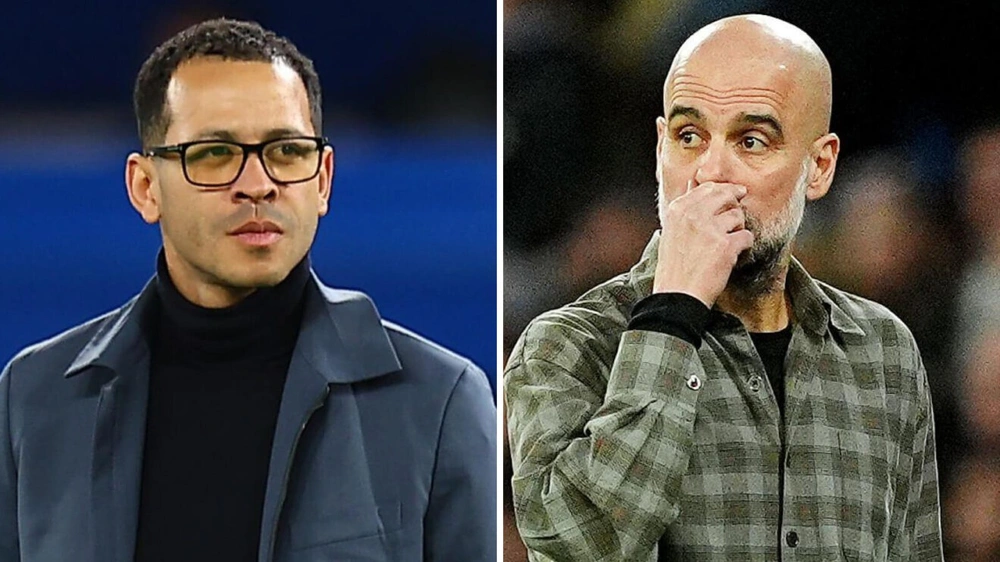
Chelsea and Manchester City had already lost from the first leg.
Conversely, Rosenior made mistakes at a more fundamental level. Moving Mamadou Sarr to play as a right-back was a failed gamble. This player directly made an error leading to an early goal, causing Chelsea to collapse from the 6th minute. Moreover, Chelsea's makeshift defense was continuously pierced by PSG into gaps, showing a clear lack of preparation.
If Guardiola failed due to stubbornness in his philosophy, Rosenior failed due to insufficient capability to build a stable system. One is a veteran coach limited by his own philosophy; the other is a novice who hasn't yet controlled the dressing room and the team's structure.
3. The match approach of both teams exposed a major problem: Failure to adapt to the specific circumstances.
Manchester City entered the second leg with a fighting spirit to "create a miracle," but their play did not reflect that. They still deployed the ball slowly, prioritizing control over acceleration. This allowed Real Madrid ample time to organize their defense and wait for mistakes. When forced to play with a man disadvantage and conceding first, City truly accelerated, but by then the match was already settled.
Meanwhile, Chelsea approached the match emotionally. Details like changing positions before each match, or the lineup being leaked, showed internal instability. On the pitch, they wanted to attack but lacked the solid organization to defend. The result was a chaotic situation where PSG easily imposed their style of play.
The notable point is that both teams failed to adjust promptly. Guardiola accepted the risks of his familiar system, while Rosenior constantly changed but without a clear direction. In top-level football, the mistake is not in choosing a wrong tactic, but in failing to recognize it's wrong and adjust.
And that is the greatest commonality: Both Manchester City and Chelsea entered decisive matches with an unsuitable approach. Consequently, they paid the price by being eliminated in a manner that was practically predetermined.


Wonderfulshortvideo
Kvaratskhelia and Ronaldo 🫶


🇪🇸 Spain 🆚 Argentina 🇦🇷
Arsenal goal today arsenal 2-1 chelsea arteta interview arteta press conference
When Diogo Costa saved EVERY penalty he faced in the shoot-out 🤯🤯🤯
The movement is electric ⚡️
Mbappe injury mbappe surgery real madrid 0-1 getafe mbappe return date mbappe edit
ronaldo almeria ronaldo buying new club ronaldo owner ronaldo manchester united owner
 Links
Links
 Contact
Address:UNIT 1804 SOUTH BANK TOWER, 55 UPPER GROUND,LONDON ENGLAND SE1 9E
Number:+85259695367
E-mali:[email protected]
 App
App


