



Tottenham: From the Metropolitano Disaster to the Quest for a 'Magical Night'



This initial period may be the most dramatic and brutal chapter in Igor Tudor's managerial career since arriving in North London. Within just a single week, the Croatian strategist went from being criticized as a "sinner" after the humiliating defeat in Madrid, to the image of a resilient leader who helped a crippled Tottenham stand firm at Anfield.
Now, before him lies the mountain named Atletico Madrid in the Champions League knockout round second leg, a challenge that will determine not only this season, but potentially his own seat at Tottenham Hotspur.
In the first leg, Tottenham traveled to Spain with some confidence, holding 5th place in the standings after the League Phase. However, 90 minutes at the Metropolitano turned into a nightmare that The Telegraph called "a systematic humiliation." Igor Tudor entered the match with a plan that was overly naive against an "old fox" like Diego Simeone.
Tactical Mistakes and the "Antonin Kinsky Case"
The focal point of the failure wasn't just the scoreline, but in Tudor's personnel decisions. The decision to name young goalkeeper Antonin Kinsky in the starting lineup for a high-pressure knockout Champions League match was a desperate gamble. Kinsky, who had been sidelined for nearly half a year with his last match in late October 2025, was completely overwhelmed by the intense atmosphere in Madrid.
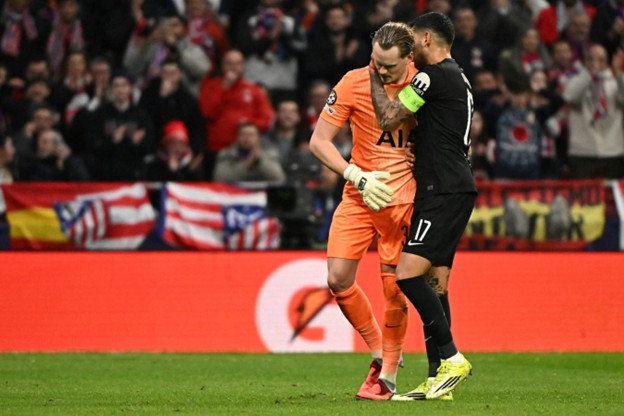
The young goalkeeper was crushed by the pressure at the Metropolitano
Tudor wanted to build a play-from-the-back style, but he thrust a young goalkeeper into a "defensive" position without adequate cover from the backline above. Kinsky's individual errors leading to an early goal were the inevitable consequence of his inexperience. However, what most angered public opinion was Tudor substituting Kinsky off during the first half itself. The Telegraph harshly criticized this action, calling it "shameful treatment." Instead of protecting his pupil, Tudor publicly turned Kinsky into a scapegoat, plunging the goalkeeper's morale into an abyss and simultaneously fracturing trust within the dressing room.
Tactically, Spurs' three-center-back formation was shredded by Atletico's sharp counterattacks. The vast spaces behind the wing-backs were exploited thoroughly by Griezmann and his teammates. Tottenham managed only 42% possession, appearing harmless, and whenever they lost the ball, they resembled a lightweight boxer trying to withstand the thousand-pound punches of a giant.
The Resilience of the "Cockerel" in the Storm
Four days after the Madrid disaster, Tottenham faced an even more terrifying challenge: Liverpool at Anfield on Super Sunday. With a severely depleted squad and morale at rock bottom, few believed Tudor could leave Merseyside with even a single point. Yet, this was when Spurs' "never give up" identity reasserted itself.
Recognizing the fragility of the defense after the Atletico loss, Tudor executed a dramatic tactical pivot with a makeshift lineup. He abandoned the malfunctioning three-center-back system to switch to a classic 4-4-2 formation, prioritizing compactness and numbers in the midfield area.
Spurs' starting lineup against Liverpool was proof of their "resilience." Missing key pillars, Tudor had to deploy Souza, a player strong in duels, as an offset right-back to directly confront Liverpool's wing assaults. The young central midfield duo Archie Gray and Pape Matar Sarr started together for the first time but displayed boundless energy, constantly moving to fill the gaps created by Liverpool's attack.
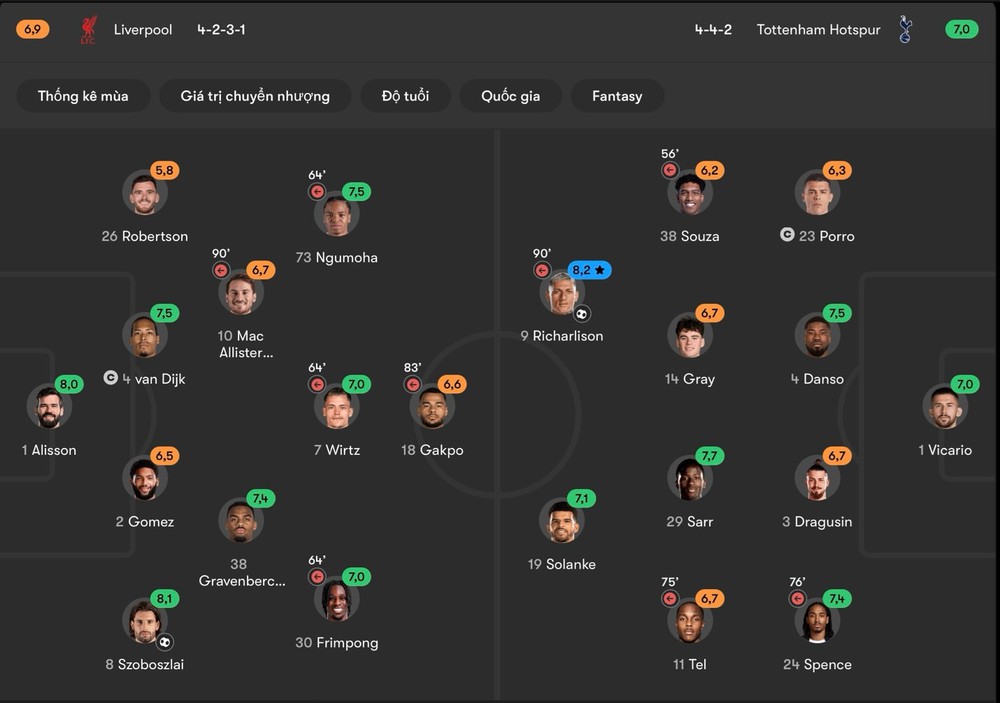
Tottenham's 4-4-2 formation when visiting Anfield
Although Szoboszlai opened the scoring for Liverpool with a sublime free-kick in the 18th minute, Tottenham did not collapse as they had in Madrid. The consistency in the 4-4-2 play helped Spurs withstand the red waves. Notably, "R9" Richarlison had a career-defining match. The Brazilian striker was not only the target for long balls but also the one directly pressuring Virgil van Dijk, the center-back considered unbeatable.
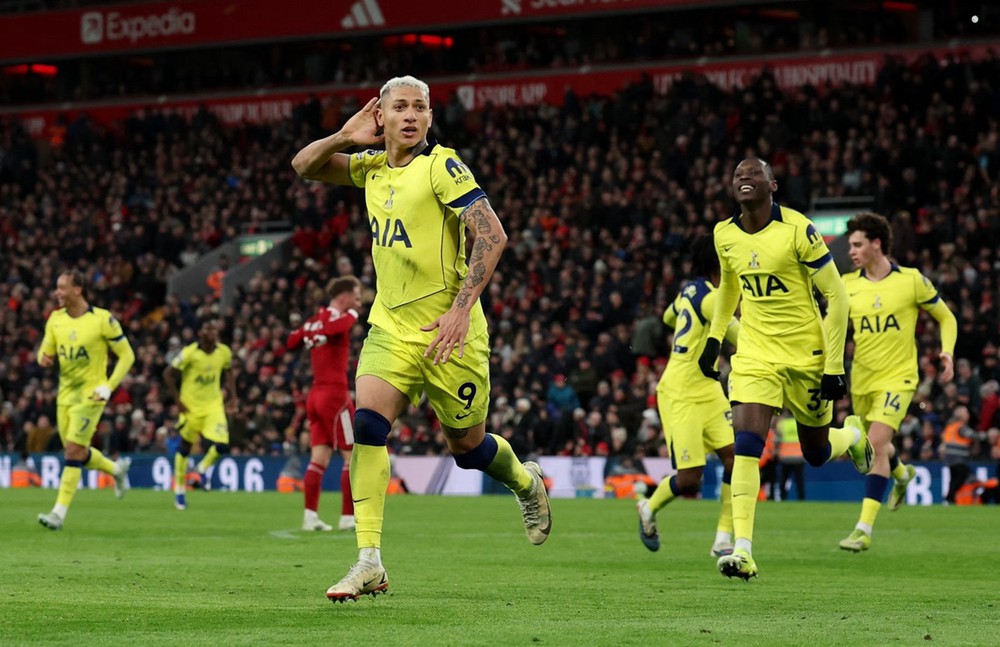
Statistics show Richarlison has a remarkable affinity with Liverpool (6 goals, 3 assists), and that affinity repeated itself precisely in the 90th minute. A play where Kolo Muani capitalized fully on Andy Robertson's mistake to deliver a perfect pass, and Richarlison did not miss. The equalizing 1-1 goal was a reward for a collective that ran tirelessly, for a Tudor who listened and adapted to the "patchwork" circumstances.
A final highlight was the debut of young talent Rowswell (under 20). Tudor introducing Rowswell during the breathless stoppage time at Anfield showed he is trying to mend relations with young players, while also expressing faith in the club's next generation after the Kinsky controversy. This draw wasn't just a point; it was a "cooling shower" relieving the immense pressure weighing on the London club.
Awaiting a "Magical Night" in London
The draw at Anfield created excellent momentum for Tottenham heading into the Champions League second leg against Atletico Madrid. Although trailing by a large margin (3 goals), belief in a comeback is kindling in North London.
Tottenham Hotspur Stadium on Champions League nights is always a difficult place to visit. With the fervent support of over 60,000 fans, Spurs need to recreate the excitement of the final minutes against Liverpool. The key is maintaining balance between attack and defense. If they continue with the 4-4-2 used against Liverpool, Spurs will have a more solid defensive foundation to thwart Simeone's counterattacks, before thinking about scoring.
To overturn the deficit against Atletico, Tottenham needs an early goal. The combination of the duo Kolo Muani and Richarlison will be key. The former PSG striker's speed and dribbling ability will play a disruptive role, stretching the opponent's defense, while Richarlison needs to maintain his killer instinct inside the box.
Additionally, Tudor must maximize set-piece situations. The Liverpool match showed how dangerous Spurs are from Tel's deliveries. Against a deep-defending Atletico, dead-ball situations or early crosses from the wings will be crucial weapons to penetrate the Spanish side's concrete block.
The biggest question for Tudor is the goalkeeper position. After the first-leg mistake, will he dare to trust Kinsky again to let his young pupil reclaim honor, or choose a safer option? Tottenham's defensive confidence heavily depends on the man behind them. If Tudor can stabilize the psychology of defenders like Danso and Dragusin, who just had an acceptable performance against Liverpool, the Croatian strategist's troops can certainly keep a clean sheet.
Overturning a deficit against a Diego Simeone team is never easy. Atletico will bring a "double-decker bus" to London and be ready to punish any minor Tottenham error. However, if Spurs play with the "nothing to lose" spirit they fought with at Anfield, plus a bit of luck and brilliance from individuals like Richarlison, a crazy script like 2019 could fully repeat.
The upcoming match is not just a football game; it is the final test for Igor Tudor's capability. A victory, even if insufficient for progression but enough to demonstrate resilience, would help him retain his seat. But if Spurs engineer a great comeback, it would be a resounding affirmation that the Cockerel has truly matured from within the storm.
Tottenham stands on the boundary between collapse and rebirth. From the "humiliation" in Madrid to the "pride" at Anfield, Igor Tudor's team has proven they can rise from the darkest moments. The midweek second leg against Atletico Madrid is precisely their chance to continue writing their mythical story. Regardless of the outcome, the spirit of the 1-1 draw against Liverpool will be the guiding principle for Spurs toward a more stable future.
Football always holds surprises, and for Tottenham, drama seems embedded in their DNA. Let's wait and see if Super Sunday at Anfield marks the beginning of the club's greatest comeback in European competition history.


Wonderfulshortvideo
Kvaratskhelia and Ronaldo 🫶


🇪🇸 Spain 🆚 Argentina 🇦🇷
Arsenal goal today arsenal 2-1 chelsea arteta interview arteta press conference
When Diogo Costa saved EVERY penalty he faced in the shoot-out 🤯🤯🤯
The movement is electric ⚡️
Mbappe injury mbappe surgery real madrid 0-1 getafe mbappe return date mbappe edit
ronaldo almeria ronaldo buying new club ronaldo owner ronaldo manchester united owner
 Links
Links
 Contact
Address:UNIT 1804 SOUTH BANK TOWER, 55 UPPER GROUND,LONDON ENGLAND SE1 9E
Number:+85259695367
E-mali:[email protected]
 App
App


