



Ranked 10th in East Asia this season! Chinese Super League stands on the brink of AFC Champions League cliff




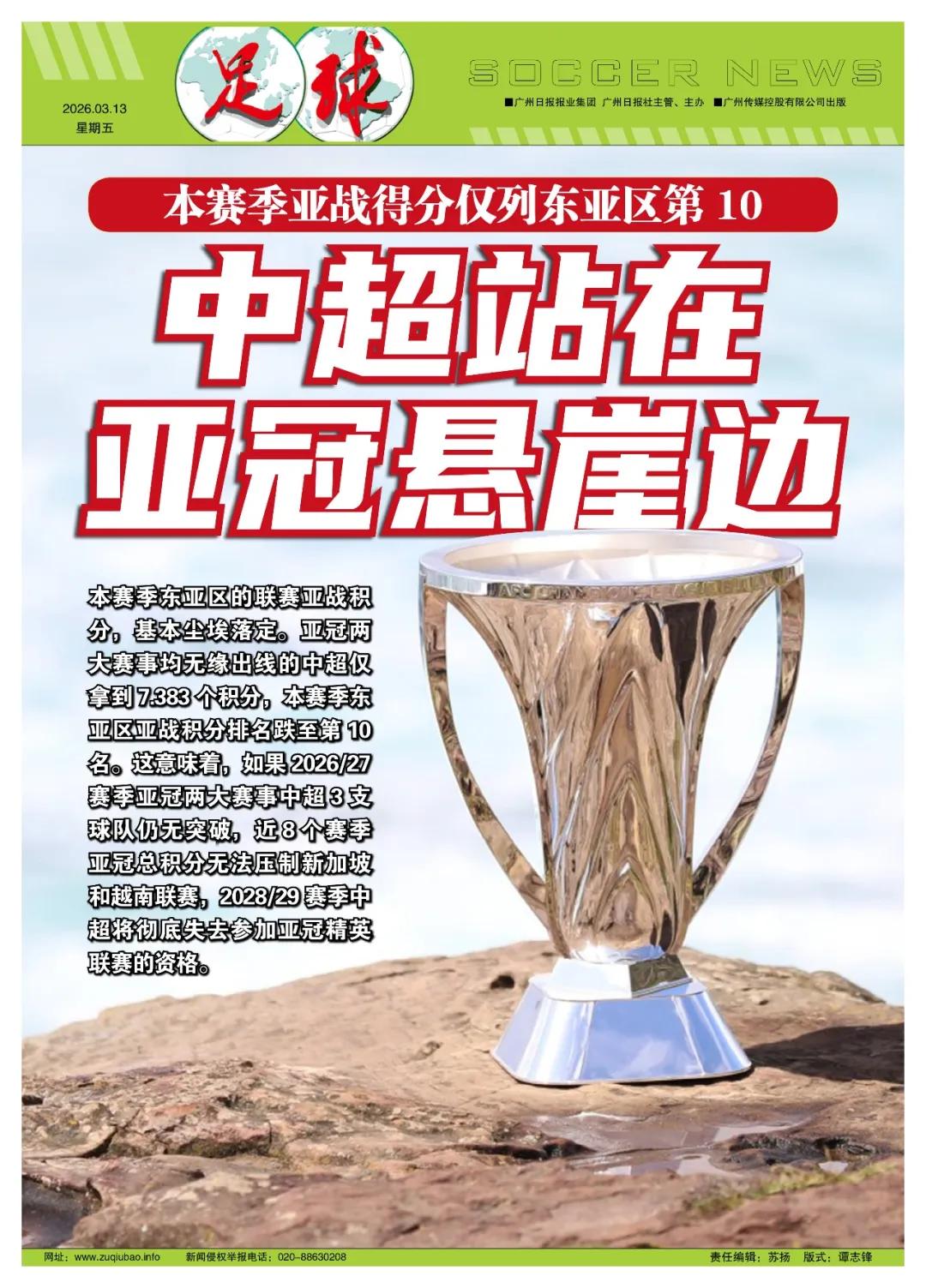
Written by Han Bing With the conclusion of this week's AFC Champions League Elite East Asia Round of 16 and AFC Champions League 2 East Asia Quarter-finals, the Elite East Asia semi-finalists are confirmed, and the two AFC Champions League 2 East Asia finalists have also emerged. The league's AFC competition points for East Asia this season are largely finalized. The J-League, with three teams still competing, leads by a wide margin, while the Chinese Super League, which failed to advance in both major AFC competitions, only secured 7.383 points, dropping to 10th place in East Asia's AFC competition points ranking this season.
This means that when the two major AFC leagues kick off in summer 2026/27, the Chinese Super League's "starting score" for the total points determining AFC competition slot allocation for 2028/29 ranks only 6th in East Asia. Not only is it far behind Japan, South Korea, and Thailand, but it also trails the Australian A-League and Malaysian Super League, with Singapore and Vietnam leagues closely chasing.
If the three Chinese Super League teams participating in the 2026/27 AFC competitions continue their poor performance as this season, the total AFC points over the past eight seasons might even fall behind Singapore and Vietnam leagues. Then, for the 2028/29 season, the Chinese Super League could completely lose eligibility for the AFC Champions League Elite, relegated to the secondary AFC Champions League 2.
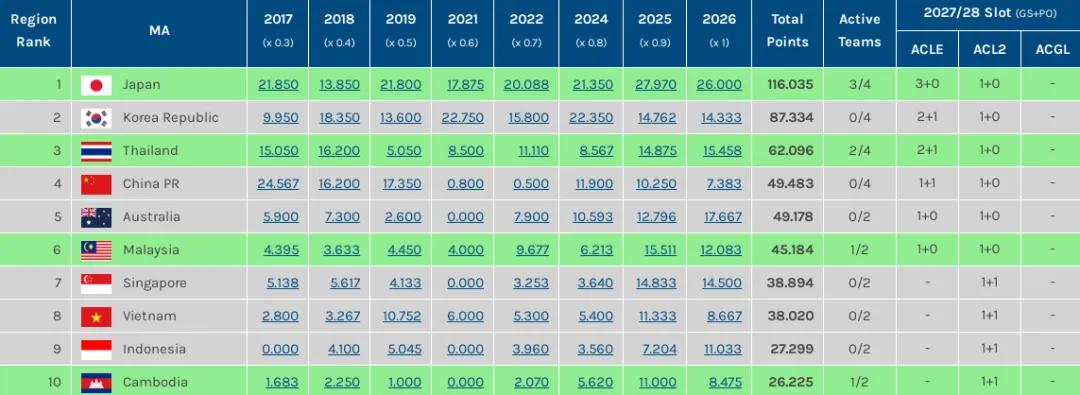
▲Current season East Asia AFC points total ranking: Chinese Super League narrowly beats A-League, but this season's points rank only 10th in East Asia, even lower than Vietnam and Cambodia leagues.

In this season's two major AFC competitions, all four Chinese Super League teams failed to advance, with a combined record of 3 wins, 10 draws, and 17 losses. This season's AFC points are only 7.383, declining for three consecutive seasons. This season's CSL points rank dropped to 10th in East Asia, while East Asia has only 12 league teams in the two AFC competitions; CSL ranks only above Philippines league (5 points) and Hong Kong Premier League (4.333 points).
This season's East Asia AFC points ranking: 1st is J-League (26 points, with three teams still competing), 2nd is A-League (17.667 points), 3rd is Thai League (15.458 points, with two teams still competing), 4th is K-League (14.333 points). Southeast Asia leagues: Singapore (14.500 points), Malaysia (12.083 points, with one team still competing), Indonesia (11.033 points), Vietnam (8.667 points), even Cambodia (8.475 points) all have higher points than CSL. J-League, Thai League, and Malaysian Super League still have teams competing in AFC, so their points may further increase.

▲This season AFC Champions League Elite East Asia semi-finalists: J-League holds two spots, Malaysia and Thailand each hold one.
In AFC Champions League Elite East Asia Quarter-finals, Buriram United eliminated Melbourne City, halting A-League's total AFC points over the past eight seasons at 49.178 points. Chinese Super League (49.483 points) thus narrowly retained, by a 0.305-point margin, two AFC Champions League Elite slots and one AFC Champions League 2 slot for 2027/28 season. But this only secures AFC slots for one season: AFC regulations allocate slots based on total AFC points ranking over the past eight seasons (excluding 2020), reassigned each season. With its total AFC points declining, CSL is already on the brink.
This season AFC Champions League Elite East Asia semi-finalists: J-League holds two spots, Thai League and Malaysian Super League each hold one; AFC Champions League 2 East Asia finalists: J-League and Thai League each hold one. Over the past eight seasons' total AFC points, Thai League (at least 62.096 points) leads CSL (49.483 points) by at least 12.613 points. A-League (49.178 points) and Malaysian Super League (at least 45.184 points) also rapidly narrowed the gap with CSL thanks to this season's significantly higher AFC points.

▲This season AFC Champions League 2 East Asia finalists: J-League and Thai League each hold one spot.

CSL can still retain three AFC slots for 2027/28 season, but considering the "golden era" (2018 and 2019) high AFC points "bonus" will be gradually excluded in the next two years, the gap between CSL and other East Asia leagues (besides Japan and South Korea) in total AFC points will widen further, making CSL's AFC Champions League Elite slots precarious.
This summer, as the new 2026/27 AFC competitions season begins, the league total points determining 2028/29 season slot allocation will start counting from 2018 season. CSL loses the exceptionally high AFC points from 2017 season (24.567 points). The "starting score" at the new season's start—total AFC points over the past seven seasons (35.675 points)—is not only far behind Thai League (at least 49.605 points), but also surpassed by A-League (41.522 points) and Malaysian Super League (at least 38.309 points).
Behind CSL, Singapore league (32.753 points) and Vietnam league (32.106 points) are closing in. This season, Singapore league teams earned 7.117 more AFC points than CSL, Vietnam league teams earned 1.284 more points than CSL; both could catch up in the new season. Given Singapore and Vietnam leagues have fewer participating teams, each win adds more AFC points than CSL, making it harder for CSL, already struggling to win, to outscore rivals.
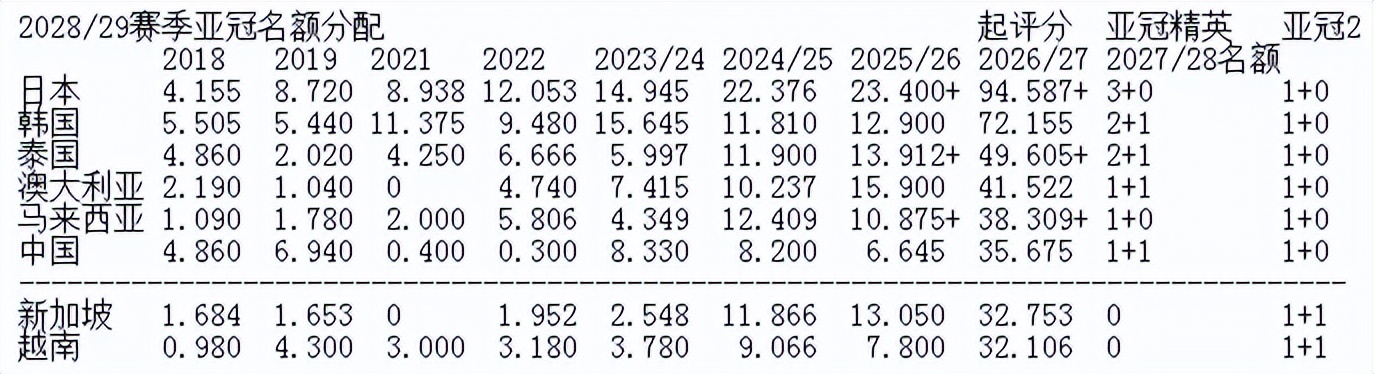
▲From the 2026/27 season starting score perspective, Singapore and Vietnam leagues are getting closer to CSL.
From this season's AFC competitions performance, Thai League and Malaysian Super League teams, unrestricted in foreign player numbers, have stronger point-scoring ability than CSL. CSL teams lost too many points against direct AFC slot competitors, with 10 matches yielding 2 draws and 8 losses without a win, causing the new season "starting score" to be overtaken by Thai League, A-League, and Malaysian Super League. For CSL, the decisive factor to retain AFC slots is ensuring stable winning rate against Southeast Asian teams. Unfortunately, each lost "six-point match" against Southeast Asian teams this season doubly widened the gap with direct AFC slot competitors.
If CSL teams continue poor AFC performance in the new season starting this summer, failing to outscore the closely pursuing Singapore and Vietnam leagues in season AFC points, under the current AFC slot allocation mechanism, the 2028/29 AFC Champions League Elite might see no CSL teams. This season, CSL was already a bystander in Elite and AFC Champions League 2 knockout stages; two years later, could CSL even fail to enter the AFC Champions League Elite threshold?


Wonderfulshortvideo
Kvaratskhelia and Ronaldo 🫶


🇪🇸 Spain 🆚 Argentina 🇦🇷
Arsenal goal today arsenal 2-1 chelsea arteta interview arteta press conference
When Diogo Costa saved EVERY penalty he faced in the shoot-out 🤯🤯🤯
The movement is electric ⚡️
Mbappe injury mbappe surgery real madrid 0-1 getafe mbappe return date mbappe edit
ronaldo almeria ronaldo buying new club ronaldo owner ronaldo manchester united owner
 Links
Links
 Contact
Address:UNIT 1804 SOUTH BANK TOWER, 55 UPPER GROUND,LONDON ENGLAND SE1 9E
Number:+85259695367
E-mali:[email protected]
 App
App


