



The Premier League's lack of excitement is not Arsenal's fault.



Amid the climax of the title race, Arsenal has suddenly become the focus of a heated debate: Are they making the Premier League less exciting?
From sarcastic nicknames to Chris Sutton's claim that this could be the "ugliest champion in history," Arsenal has been cast as the scapegoat for nostalgia about a more free-flowing, open, and instinctive style of football.
More prejudice than truth
The most repeated argument is that Arsenal relies too heavily on set-pieces, particularly corners. Their record-equaling number of goals from corners in a Premier League season has provided perfect fodder for ridicule. However, when the numbers are put into context, the story is completely different.
Arsenal scored 22 of their 58 goals from set-pieces, which is 38%. This figure is actually lower than Chelsea's efficiency (39%), Leeds' (46%), Newcastle's (49%), or Crystal Palace's (50%). This means that in terms of reliance on dead-ball situations, Arsenal ranks only 5th.
They also rank behind only Manchester City in goals from open play, a notable fact considering key creative players like Bukayo Saka, Kai Havertz, and Martin Odegaard have missed significant time due to injury. A team that is effective from set-pieces while also maintaining a threat from open play can hardly be called one-dimensional. It's important to remember that corners don't just happen. They result from attacking pressure, from shots that force defensive clearances, from sustained periods of dominance. Arsenal winning more corners than most opponents reflects their superior control and attacking prowess.
Two decades ago, the pace and tactical structure of the game were vastly different. Today, every club invests in analysts, set-piece coaches, data, and sports science. Arsenal is simply doing what every other team strives for: optimizing their strengths.
If anything deserves criticism, it's the inability of opponents to stop a tactic that has been "decoded" for months. In elite sport, a strategy only becomes obsolete once it is consistently countered. As long as Arsenal keeps scoring from it, it means the rest of the league hasn't found the solution.
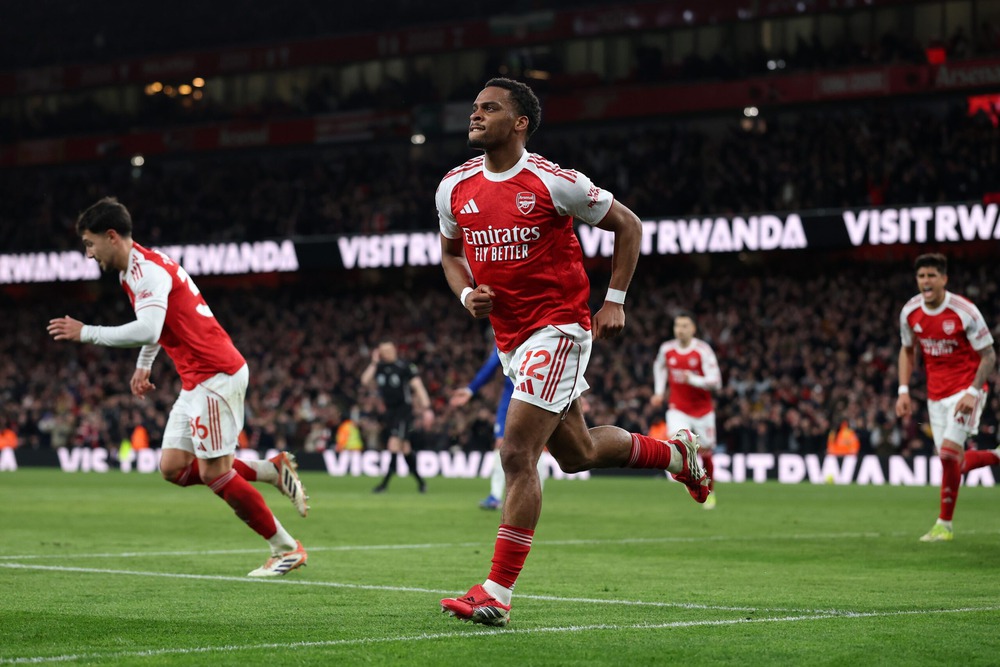
Timber scores the decisive goal against Chelsea from a corner.
Arsenal is a model of sustainability.
Blaming Arsenal for the league's supposed "lack of excitement" also ignores the broader, dynamic picture of the season.
Arsenal could win their first title in 22 years, while Tottenham struggles near the bottom. Manchester United defeats title contenders but gets eliminated from domestic cups at Old Trafford. Newcastle wins the League Cup then risks falling into the bottom half. Crystal Palace triumphs in the FA Cup only to be shockingly eliminated by a lower-league side. Meanwhile, free-spending Chelsea remains inconsistent in the race for Champions League qualification.
If that is "boring," then the concept of entertainment has become unrealistic.
Off the pitch, Arsenal represents a different approach in an era of financial instability in football. Their 2024-25 financial report shows they are nearly break-even, with a loss of only around £1 million. In contrast, Chelsea posted a record loss of £355 million, while the financial charges against Manchester City remain unresolved.
Over the past three years, Arsenal has nearly doubled its commercial revenue, renewed and expanded its deal with Emirates, aggressively pursued the American market, and risen to the top tier in total revenue, surpassing Manchester United, Tottenham, and Chelsea. This is the result of a long-term strategy, rooted in the decision to build the Emirates Stadium two decades ago—a decision for which Arsene Wenger was criticized but is now seen as visionary.
In an era where many clubs are questioned for "bending" financial rules, a team competing for the title without plunging into unsustainable spending sprees deserves recognition. Arsenal demonstrates that you can grow, optimize resources, and build a competitive squad without breaking a sustainable structure.
Football always moves in cycles. A dominant tactic will eventually be countered. A risky financial model will eventually face consequences. Arsenal is currently at the peak of its cycle, where thorough preparation, smart governance, and meticulous optimization provide an edge. Instead of labeling them as "spoilsports," perhaps Arsenal should be seen as proof that the Premier League is not in decline, but maturing. It may have fewer open spaces and more structure, but it is also more ruthless and competitive than ever.
Arsenal is not the reason the league is less exciting. They are simply the team executing what modern football demands most effectively. And if they win the title, it won't be a victory of "ugly" football, but a victory of evolution.


Wonderfulshortvideo
Kvaratskhelia and Ronaldo 🫶


🇪🇸 Spain 🆚 Argentina 🇦🇷
When Diogo Costa saved EVERY penalty he faced in the shoot-out 🤯🤯🤯
The movement is electric ⚡️
Never gives up 💪
Things you really love to see
Neymar highlights neymar edit neymar lamine yamal celebration
 Links
Links
 Contact
Address:UNIT 1804 SOUTH BANK TOWER, 55 UPPER GROUND,LONDON ENGLAND SE1 9E
Number:+85259695367
E-mali:[email protected]
 App
App


