



The J1 Century Vision League kicks off tomorrow: transitioning to a cross-year season in 4 months, what insights does it offer?




Written by Han Bing On February 6th, the J1 "Century Vision" League — a transitional season before the J1 League switches to a cross-year schedule — starts, lasting just 4 months. The J.League adopts the cross-year format to synchronize completely with European leagues and the AFC Champions League. The summer transfer window occurs before the season rather than mid-season, benefiting players moving abroad; players also avoid the intense heat of July. Preseason training and match schedules align with European and AFC leagues, enabling teams and players to perform at their best.
On February 2nd, the opening ceremony of the J1 "Century Vision" League was held at the Mitsubishi UFJ Financial Group Stadium (Tokyo National Stadium), featuring a speech by J.League chairman Yoshiyuki Nonomura and the collective appearance of all 20 J1 team captains.
The "Century Vision" League adopts an East-West divisional format, with the J1 (20 teams) and J2/J3 leagues (totaling 40 teams) competing within their respective divisions.
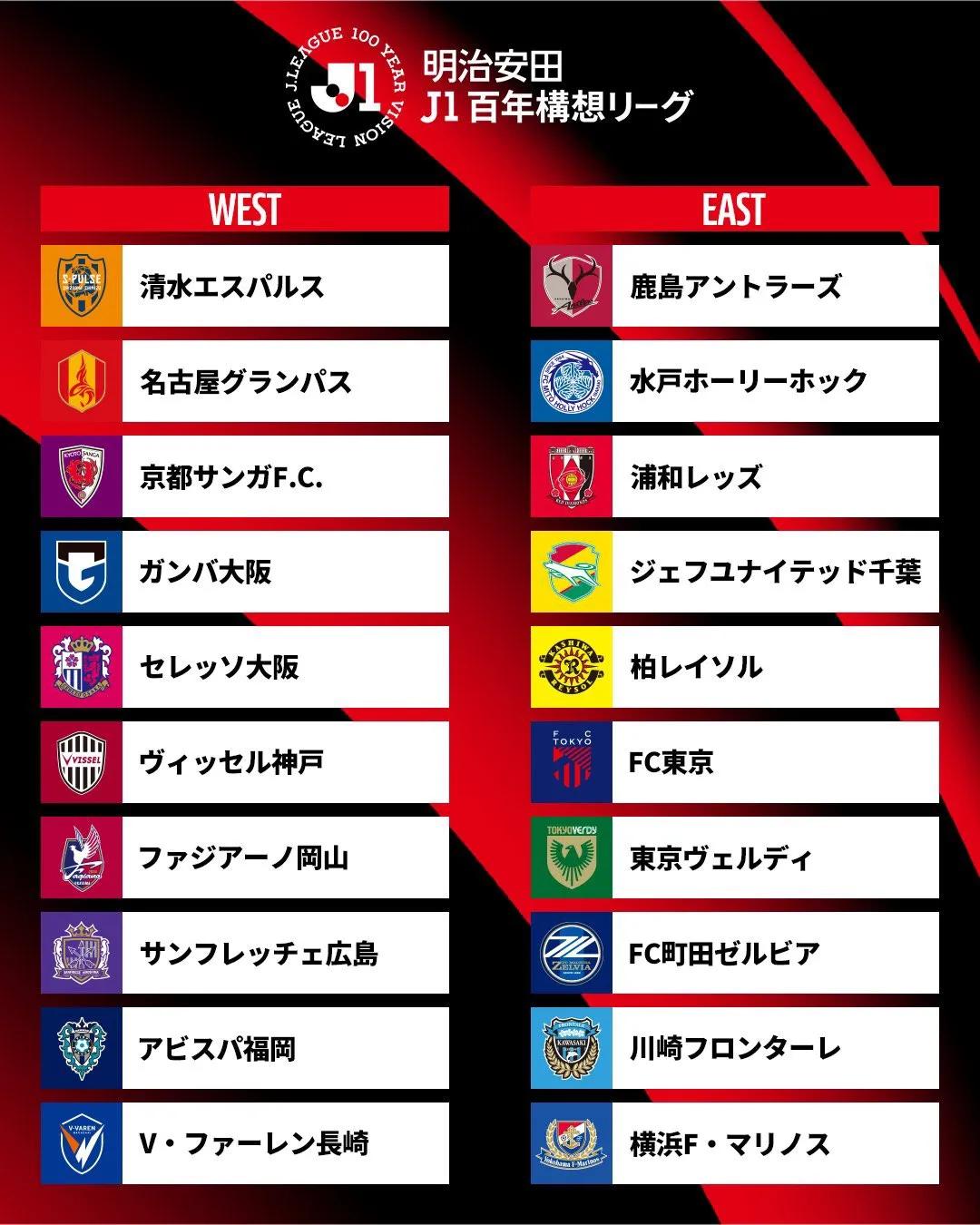
The 20 J1 teams are split into East and West divisions, each containing 10 teams. The East division consists of 10 teams from the Kanto region: Kashima Antlers, Mito HollyHock, Urawa Red Diamonds, Ichihara Chiba, Kashiwa Reysol, FC Tokyo, Tokyo Verdy, Machida Zelvia, Kawasaki Frontale, and Yokohama F. Marinos. The West division includes 10 teams west of Kanto: Shimizu S-Pulse, Nagoya Grampus, Kyoto Sanga, Gamba Osaka, Cerezo Osaka, Vissel Kobe, Fagiano Okayama, Sanfrecce Hiroshima, Avispa Fukuoka, and V-Varen Nagasaki. As a transitional season, the J1 "Century Vision" League has no promotion or relegation. To motivate participation, the league has implemented significant changes in competition format and rewards.
The regional East and West divisions run from February 6 to May 24, with each division’s 10 teams playing a double round-robin home-and-away format, totaling 18 rounds. Draws are eliminated: if tied after regular time, matches go straight to penalty shootouts. Winners earn 2 points, losers 1 point.
The playoffs take place on May 30/31 and June 6/7, with teams from corresponding ranks in each division facing off in two-legged home-and-away matches to determine final standings. The East division’s first-place team competes against the West’s top team; the winner is crowned transitional season champion and secures a spot in the 2026/27 AFC Champions League Elite Stage. Additionally, on June 13, the J1 League will hold its first All-Star Game in 17 years.
The J1 League offers generous prize money for points, championship, and additional bonuses, totaling 2.52 billion yen (approximately 117 million RMB). Each point is worth 2 million yen (about 88,700 RMB). The champion prize is 150 million yen (approx. 6.65 million RMB), runner-up 60 million yen (approx. 2.66 million RMB), and third place 30 million yen (approx. 1.33 million RMB). Moreover, all teams will receive extra bonuses called "Ideal Enhancement Grants" based on final rankings and popularity standings.
Teams from northern snowy regions usually face continuous away matches in southern areas during heavy snowfall periods. However, the J1 "Century Vision" League and the 2026/27 J1 season do not include any snow-region teams, so this issue does not arise at least for this year and the first cross-year season.
In contrast, the combined 40 teams in J2/J3 include as many as 12 "snow-region" teams. The J2/J3 leagues are divided into four groups: East (Groups A and B) and West (Groups A and B). These 12 snow-region teams are distributed among the four groups, with no more than four per group. This year’s J2/J3 "Century Vision" League and the 2026/27 cross-year season will test the impact of snowy climates on the new format, and whether schedule adjustments and investments in weather-resistant training and match facilities are effective.
Previously, Southeast Asian countries such as Thailand (2020), Vietnam (2023), Malaysia, Singapore, and the Philippines (2024) switched to cross-year formats, though their transitional approaches varied. Vietnam’s first half transitional season had 14 teams playing 13 rounds in a single round-robin, splitting into a top 8 championship group and a bottom 6 relegation group, but no continental qualification was awarded. Indonesia, Singapore, and the Philippines held cup competitions in the first half before starting cross-year seasons. Thailand delayed its league start to September due to the pandemic to enter the cross-year format, while Malaysia postponed its season start to May for the same purpose.
The J1 "Century Vision" League is one of the most closely watched Asian leagues transitioning from a calendar year to a cross-year schedule in recent years. Unlike Southeast Asian leagues without climate concerns, J1’s divisional format, elimination of draws, and scheduling adjustments provide valuable reference points for other Asian countries in East and Central Asia facing similar climate variations.


Wonderfulshortvideo
Things you really love to see


Neymar highlights neymar edit neymar lamine yamal celebration
Arsenal 1-0 chelsea havertz goal
Ahead of his 100th cap, Sir Keir Starmer had this message for Maro Itoje…
yamal goal yamal instagram yamal dribble barcelona 2-1 albacete yamal highlights yamal edit
casemiro goal casemiro assist casemiro 6 7 celebration
"Can I just start off by saying I want to congratulate Maro on 100 tests... He's a great bloke and a great player."
 Links
Links
 Contact
Address:UNIT 1804 SOUTH BANK TOWER, 55 UPPER GROUND,LONDON ENGLAND SE1 9E
Number:+85259695367
E-mali:[email protected]
 App
App


