



MLB officially introduces the electronic strike zone this year, with strikeout rates expected to slightly decrease.



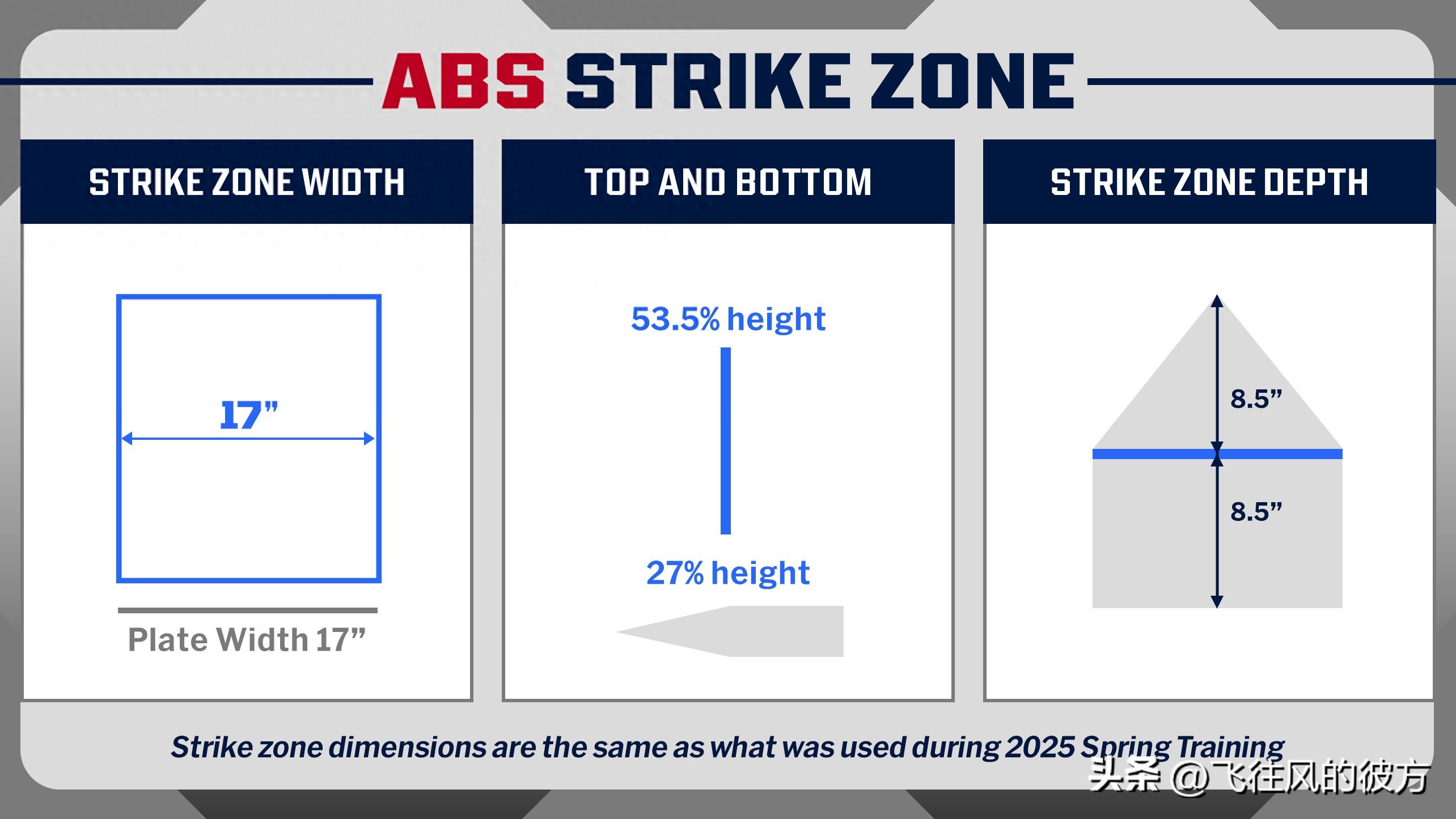
Beginning this season, MLB will adopt a comprehensive challenge system using the electronic strike zone. To clarify common fan concerns—why the electronic strike zone isn’t 3D, why it isn’t positioned at the front of home plate, and its impact on strikeouts and walks—Anthony Castrovince from MLB’s official site has written a detailed analysis.
The electronic strike zone used by MLB is not computer-judged on every pitch but operates under a challenge system. Each team gets two challenges during the first nine innings; the computer review is only triggered when a challenge is made. A successful challenge preserves the team’s challenge opportunity, while a failed one consumes it. In extra innings, each team is guaranteed at least one challenge per inning: if none were used in the previous inning, no additional challenge is added; if all were used, one challenge is restored in the next inning.
According to the rules, only the pitcher, catcher, and batter involved in the pitch can initiate a challenge. The challenge signal is made by touching the palm to the top of the head, and the stadium’s big screen immediately displays the electronic strike zone and the ball’s location. During spring training in 2025, 288 games trialed the electronic strike zone, averaging 4.1 challenges per game, each lasting about 13.8 seconds, extending each game by roughly 57 seconds.
Based on minor league trial data, the success rate for challenges at the Triple-A level in 2025 is about 50%, with catchers having the highest success rate and pitchers the lowest. By innings, the success rate is 60% in innings 1 to 3, 51% in innings 4 to 6, dropping to 43% in innings 7 and 8, and 46% in the 9th inning.
No one other than the pitcher, catcher, or batter is allowed to challenge. If the home plate umpire detects that someone else signals for a challenge, they can refuse to initiate it. If an instant replay challenge is also requested simultaneously, replay challenges take priority to prevent back-to-back challenges from disrupting the game’s pace. Such refused challenges do not count against the team’s allotted challenges.
Unlike the three-dimensional strike zone defined in baseball rules, the electronic strike zone is a flat plane located exactly at the center of home plate, matching the plate’s width. Its upper boundary is set at 53.5% of the batter’s height without shoes, and the lower boundary at 27% of that height. Since its first trial in independent leagues in 2019 and ongoing minor league testing since 2022, this method best aligns with the current strike zone definition.
MLB previously experimented with a three-dimensional electronic strike zone but found that breaking balls near the edges caused inconsistent calls due to varying trajectories. Therefore, they chose a flat plane design. Placing the strike zone at the front edge of home plate, as seen on TV broadcasts, also produced odd calls, so MLB decided to position it in the middle of the plate. The plate is 17 inches (43.2 cm) long, with the strike zone set 8.5 inches (21.6 cm) inward from the front edge.
Reducing the electronic strike zone width to match the home plate’s width helps avoid balls clearly outside the actual strike zone being called strikes, though objectively, it also shrinks the strike zone. Minor league test data shows that strikeout rates slightly decrease while walk rates see a modest increase as a result.
Currently, the Statcast system occasionally fails to track some pitches, and the electronic strike zone using the same Hawk-Eye high-speed camera system faces similar issues. During last year’s spring training trials, 4 out of 88,534 pitches were not tracked due to malfunctions. When officially implemented, if such cases occur, the original call will stand, and teams will not lose their challenge opportunity.


Wonderfulshortvideo
“There isn’t a single sorcerer who doesn’t know of Satoru Gojo” 🤣


Baseball is back!
When you’re on a field trip at Dodger Stadium and Kyle Tucker waves to you. 🥹
A message from King Tuck!
What’s up from DodgerFest. 😂
THE WAIT IS ALMOST OVER! 😭
How can you not be romantic about baseball 😂
 Links
Links
 Contact
Address:UNIT 1804 SOUTH BANK TOWER, 55 UPPER GROUND,LONDON ENGLAND SE1 9E
Number:+85259695367
E-mali:[email protected]
 App
App


